
How many calories are in a packet of Quaker instant oatmeal?
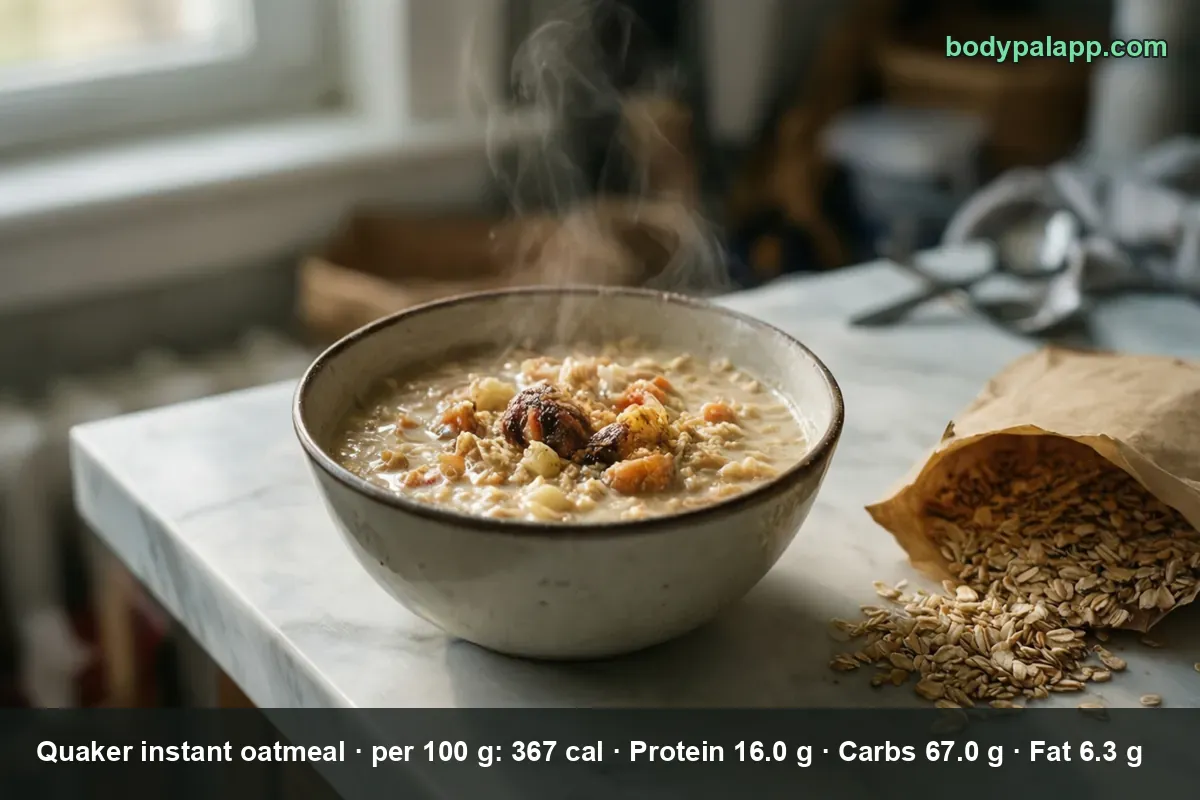
One packet of plain Quaker instant oatmeal weighs 41 g and holds 150 calories. The dry cereal runs 367 calories per 100 g, which is where every other number on this page starts. Water adds nothing, so the cooked bowl in front of you is still 150 unless you stir something into it.
On this page
- Quaker instant oatmeal quick facts
- Packets, cups and dry ounces
- Flavored packets, from maple to weight control
- Sodium is the row the flavors move
- How does Quaker instant oatmeal compare?
- Most popular quaker instant oatmeal brands
- Quaker instant oatmeal FAQs
Quaker instant oatmeal quick facts
The record behind this page is USDA SR Legacy 174660, "Cereals, QUAKER, Instant Oatmeal Organic, Regular". It is the plain, unsweetened packet: 1 g of total sugars per 100 g and 4 mg of sodium, which is what oats look like before a flavor is mixed in. It also carries its own USDA household measure, one packet, so the headline number is measured rather than scaled.
If you are holding a maple or apple packet instead, scroll to the variants table. Those are separate USDA rows with their own sugar and salt, and the gap comes from how the product is mixed, not from a different source or a different oat.
| Nutrient | Per 100 g | Per 1 packet (41 g) | % Daily Value |
|---|---|---|---|
| Calories | 367 | 150 | — |
| Total fat | 6.3 g | 2.6 g | 3% |
| Saturated fat | 1.11 g | 0.5 g | 2% |
| Carbohydrate | 67 g | 27.5 g | 10% |
| Dietary fiber | 9.8 g | 4.0 g | 14% |
| Total sugars | 1 g | 0.4 g | — |
| Protein | 16 g | 6.6 g | 13% |
| Sodium | 4 mg | 2 mg | 0% |
% Daily Value is based on a 2,000-calorie diet.
Verified nutrition data
Numbers on this page come from USDA FoodData Central, the U.S. Department of Agriculture’s food composition database, and from manufacturer labels where a branded product is named. Last verified September 2026. How we verify our data →
There is no added sugars row above because USDA does not publish added sugars for this record. Cholesterol is 0 mg, as you would expect from a grain. Potassium comes to 144 mg a packet, 3% of the FDA Daily Value, which is modest for a food people think of as hearty.
One more thing worth knowing before you log it. Quaker's own label for the plain cereal lists 1/2 cup (40 g) at 160 calories, while the USDA row scales to 147 for that same 40 g. Label rounding explains the 13-calorie gap; it is the same oat in both cases. The Original single packet on the label is smaller still at 28 g and 100 calories, so two products sharing the word "packet" can be 50 calories apart.
Packets, cups and dry ounces
| Serving | Weight | Calories |
|---|---|---|
| 1 oz dry | 28.4 g | 104 kcal |
| 1/2 cup dry | 40 g | 147 kcal |
| One packet | 41 g | 150 kcal |
| Two packets | 82 g | 301 kcal |
| Per 100 g | 100 g | 367 kcal |
Only the packet is a USDA household measure. The half cup, the ounce and the two-packet line are our own arithmetic from the USDA 100 g figure, not USDA servings, and they are rounded the same way the packet is.
The half cup is the line that catches people. Dry oats measured by volume weigh close to a full packet, so a "half cup, that's nothing" bowl is 147 calories before the milk goes in. Then the oats absorb water and triple in volume, and the finished bowl looks like a much bigger meal than the packet ever did. Volume is a poor guide here; weight and the packet count are reliable.
Two packets, the standard move for anyone who finds one thin, is 301 calories and 8.0 g of fiber. That is still a light breakfast by most standards, and it uses 13.2 g of protein worth of your day.
Flavored packets, from maple to weight control
Flavored Quaker packets are their own USDA rows, and the surprise is how little the calories move. The five packet-sized rows all land between 155 and 162 calories. The sugar and the sodium are where the flavor actually lives.
| Version | Per 100 g | Serving | Calories | Sugars | Sodium |
|---|---|---|---|---|---|
| Plain, unsweetened | 367 kcal | 41 g | 150 kcal | 0.4 g | 2 mg |
| Maple & Brown Sugar | 368 kcal | 43 g | 158 kcal | 12.9 g | 218 mg |
| Apples & Cinnamon | 366 kcal | 43 g | 157 kcal | 12.4 g | 195 mg |
| Raisin & Spice | 360 kcal | 43 g | 155 kcal | 15.3 g | 189 mg |
| Cinnamon-Spice | 369 kcal | 43 g | 159 kcal | 9.1 g | 179 mg |
| Weight Control, Cinnamon | 361 kcal | 45 g | 162 kcal | 0.6 g | 278 mg |
| Cinnamon Swirl, high fiber | 366 kcal | 28.4 g | 104 kcal | 4.2 g | 134 mg |
Serving weights, sugars and sodium in that table are scaled from each USDA 100 g row, our arithmetic rather than USDA servings, since the flavored rows are published dry per 100 g. The Cinnamon Swirl line is a 28.4 g dry ounce, not a packet.
Read it across and the pattern is blunt. Maple & Brown Sugar costs eight calories more than plain and thirty-two times the sugar: 12.9 g against 0.4 g. Raisin & Spice is the sweetest of the set at 15.3 g a packet, because the raisins bring their own sugar on top of what is mixed in. Among the 43 g flavored packets, Cinnamon-Spice is the mildest at 9.1 g.
The Weight Control packet is the odd one. It has the most calories in the table at 162, because the packet is bigger at 45 g, and almost no sugar at 0.6 g, because it is sweetened without it. It also carries 5.9 g of fiber and 7.4 g of protein a packet. If protein per packet is what you are after, that packet leads the flavored set at 7.4 g, and the plain packet at 6.6 g is close behind.
The Cinnamon Swirl high-fiber row is the fiber outlier: 22.3 g per 100 g, more than double the plain oats, because fiber is added to the mix. A dry ounce of it is 6.3 g of fiber for 104 calories, which is a rare ratio in a breakfast cereal.
Sodium is the row the flavors move
Plain instant oats are effectively sodium-free: 2 mg a packet, 0% of the Daily Value. Add a flavor and you are at 218 mg for Maple & Brown Sugar, 9% of the day, or 278 mg for Weight Control, 12%. Same oat, same calorie ballpark, a hundredfold jump in sodium.
That matters because breakfast is not usually where people expect their salt. CDC puts most US adults well above the 2,300 mg daily limit, and two flavored packets get you to roughly a fifth of it before you touch lunch. If you are watching sodium, plain packets with your own fruit are the better pick, and they cost you nothing in calories.
The fiber side runs the other way. A plain packet delivers 4.0 g, 14% of the Daily Value, from a food that MyPlate counts as a whole grain. Two packets get you to 8.0 g, more than a quarter of the day, for 301 calories. Very few breakfasts at that calorie level do better.
How does Quaker instant oatmeal compare?
| Hot cereal, dry | Per 100 g | US serving | Calories | Protein per 100 g |
|---|---|---|---|---|
| Quaker instant oatmeal, plain | 367 kcal | 1 oz dry, 28.4 g | 104 kcal | 16 g |
| Cream of Wheat, instant | 366 kcal | 1 oz dry, 28.4 g | 104 kcal | 10.6 g |
| Quaker instant grits, butter flavor | 369 kcal | 1 oz dry, 28.4 g | 105 kcal | 8.12 g |
| Malt-O-Meal, original | 365 kcal | 1 oz dry, 28.4 g | 103 kcal | 11.8 g |
Our take: by calories these four are the same breakfast. All of them land within two calories of each other per dry ounce, so switching hot cereals to save calories is wasted effort. Protein is where they separate, and oatmeal wins it outright at 16 g per 100 g, close to double the 8.12 g in the buttered grits and half again the Cream of Wheat. Pick oatmeal for the protein and the fiber, pick your portion by weight, and stop worrying about which box is lighter.
Most popular quaker instant oatmeal brands in the United States
Ranked by how widely each product appears among foods sold in the United States, from the BodyPal food database of over 3.3 million products. Calories are the figures printed on each Nutrition Facts label, checked against USDA FoodData Central.
| Product | Calories (per 100 g) |
|---|---|
| Quaker Instant Oatmeal (plain) | 400 cal |
| Quaker Instant Oatmeal Apples & Cinnamon | 372 cal |
| Quaker Instant Oatmeal Maple & Brown Sugar | 375 cal |
| Quaker Instant Oatmeal Honey & Almonds | 380 cal |
| Quaker Instant Oatmeal Apples & Cranberries | 353 cal |
| Quaker Instant Oatmeal Original | 357 cal |
Brand popularity: BodyPal food database. Nutrition: manufacturer labels / USDA FoodData Central.
Quaker instant oatmeal FAQs
How many calories are in one packet of Quaker instant oatmeal?
One packet of plain Quaker instant oatmeal weighs 41 g and carries 150 calories, from a dry cereal that runs 367 calories per 100 g. That packet also brings 6.6 g of protein and 4.0 g of fiber, 14% of the Daily Value. Cooking it in water changes the volume, not the calorie count.
How many calories in Quaker Maple & Brown Sugar instant oatmeal?
A Maple & Brown Sugar packet of 43 g is 158 calories, only eight more than the plain packet. The sugar and the salt are what move: 12.9 g of total sugars against 0.4 g, and 218 mg of sodium against 2 mg. Calories barely notice the flavoring.
How much sugar is in a packet of Quaker instant oatmeal?
Plain Quaker instant oatmeal has 0.4 g of total sugars in a 41 g packet, effectively none, because oats bring almost no sugar of their own. Flavored packets are a different food: 12.9 g in Maple & Brown Sugar and 15.3 g in Raisin & Spice, both 43 g. USDA does not publish added sugars for these records.
Does cooking oatmeal with water add calories?
No: water carries zero calories, so a packet cooked into a bowl is still 150 calories, however thick or thin you make it. Milk is the change worth logging, since it sits on top of the oats rather than inside them. The bowl looks three times bigger; the number does not move.
How many calories in 1/2 cup of dry Quaker instant oatmeal?
Half a cup of dry oats weighs about 40 g and comes to 147 calories, our own arithmetic from the USDA 100 g figure of 367 rather than a USDA serving. That is within three calories of a whole 41 g packet, which is the trap: dry cups weigh more than people expect.
How much fiber is in Quaker instant oatmeal?
A 41 g packet of plain Quaker instant oatmeal has 4.0 g of dietary fiber, 14% of the Daily Value, from 9.8 g per 100 g. The Cinnamon Swirl high-fiber version is the outlier at 22.3 g per 100 g, or 6.3 g in a dry ounce, because fiber is added to that mix.
How much protein is in Quaker instant oatmeal?
Plain Quaker instant oatmeal gives 6.6 g of protein per 41 g packet, 13% of the Daily Value, at 16 g per 100 g. That is the highest protein figure among the hot cereals compared on this page, close to double the 8.12 g in Quaker instant grits.
Is Quaker instant oatmeal high in sodium?
Plain is not: 2 mg of sodium in a 41 g packet, 0% of the Daily Value. Flavored packets are, relatively: 218 mg in Maple & Brown Sugar, 195 mg in Apples & Cinnamon and 278 mg in a Weight Control packet, which is 12% of the day in one breakfast.
Similar foods
- Toast with butter — 100 cal per slice with butter
- Pancake — 423 cal for 3 medium pancakes
- Crepe — 179 cal per crepe
- Omelet — 305 cal for 3-egg omelet
- Egg — 72 cal per large egg
- Cinnamon Roll — 335 cal plain, 407 frosted
Count it without the math
Point the camera at the bowl and BodyPal counts the oats for you, packet or half cup.


How long does it take to burn off 150 kcal of Quaker oatmeal?
One packet (41 g) is 150 kcal. Enter your weight and the amount you ate to see how long it takes you to burn that off:
lb
| Activity | Time to burn 150 kcal |
|---|---|
| Walking, brisk | 30 min |
| Cycling, moderate | 19 min |
| Swimming, moderate | 21 min |
| Jogging | 18 min |
| Weight training, moderate | 33 min |
Times are for a 155 lb adult at a steady pace; change the weight to see yours. The amount is set to the portion in the text (41 g); change it to what you actually ate. BodyPal works this out from your steps automatically.
One food is easy to picture; a whole day is harder. See how many calories you need a day and what a deficit actually looks like.