
How many calories are in shrimp alfredo?
A 1-cup serving of shrimp alfredo weighs 224 g and carries 320 calories. Per 100 g the dish runs 143 calories, which is modest for a cream-sauce pasta. The number that trips people up is the plate, not the recipe. A restaurant portion is closer to 1.5 cups, and that changes everything.
On this page
- Shrimp alfredo quick facts
- US servings, from half a cup to a restaurant plate
- Sauce, no sauce, and the frozen boxes
- Saturated fat and cholesterol are the rows to watch
- How does shrimp alfredo compare?
- Most popular shrimp alfredo brands
- FAQ
Shrimp alfredo quick facts
The number below comes from FNDDS 2706556, "Shrimp and noodles with cream or white sauce", the USDA survey record that matches what most people mean by shrimp alfredo: pasta, shrimp and a white cream sauce, cooked and served. It is the only entry with a full nutrient profile and a household measure attached, which is why it anchors the page instead of a frozen brand code.
Branded packages exist in the same database, but each one describes a specific box from a specific factory. A Lean Cuisine tray and a homemade skillet are not the same food, so the boxes get their own section further down rather than being blended into the main figure.
| Nutrient | Per 100 g | Per 1 cup (224 g) | % Daily Value |
|---|---|---|---|
| Calories | 143 | 320 | — |
| Total fat | 5.32 g | 11.9 g | 15% |
| Saturated fat | 1.87 g | 4.2 g | 21% |
| Carbohydrate | 16.25 g | 36.4 g | 13% |
| Dietary fiber | 0.7 g | 1.6 g | 6% |
| Total sugars | 1.66 g | 3.7 g | — |
| Protein | 7.14 g | 16.0 g | 32% |
| Sodium | 162 mg | 363 mg | 16% |
| Cholesterol | 56 mg | 125 mg | 42% |
| Potassium | 96 mg | 215 mg | 5% |
% Daily Value is based on a 2,000-calorie diet.
Verified nutrition data
Numbers on this page come from USDA FoodData Central, the U.S. Department of Agriculture’s food composition database, and from manufacturer labels where a branded product is named. Last verified September 2026. How we verify our data →
Two rows you would see on a package label are missing here: added sugars and trans fat. This edition of the USDA survey database does not publish either value for mixed dishes, so rather than guess, we leave them out. Total sugars are shown, and at 3.7 g per cup they come from the milk solids in the sauce, not from anything sweet in the pan.
The Daily Values used throughout this page are the FDA reference amounts printed on every US Nutrition Facts label.
US servings, from half a cup to a restaurant plate
| Serving | Weight | Calories |
|---|---|---|
| 1 oz | 28 g | 41 kcal |
| Half a cup, side portion | 112 g | 160 kcal |
| 1 cup, USDA household measure | 224 g | 320 kcal |
| USDA "quantity not specified" | 280 g | 400 kcal |
| 1.5 cups, restaurant plate | 336 g | 480 kcal |
| Per 100 g | 100 g | 143 kcal |
Only two of these come straight from USDA: the 1-cup measure at 224 g and the odd-sounding "quantity not specified" portion at 280 g, which is the survey's stand-in for people who reported eating shrimp alfredo without saying how much. The half cup, the 1.5-cup plate and the ounce are our own arithmetic from the USDA 100 g figure, not USDA servings.
That 1.5-cup line is the one worth staring at. A cup of pasta looks small on a wide restaurant plate, and kitchens plate to fill the dish, not to hit a measure. The same food, at the size it usually arrives, is 480 calories instead of 320 — a 160-calorie gap created by nothing except the amount on the plate. If you log shrimp alfredo out of a restaurant as "one cup," you are probably a third light.
At home the opposite happens. A half-cup side next to a piece of fish is 160 calories, which is less than most people would guess for anything described as alfredo.
Sauce, no sauce, and the frozen boxes
| Version | Per 100 g | Typical serving | Calories |
|---|---|---|---|
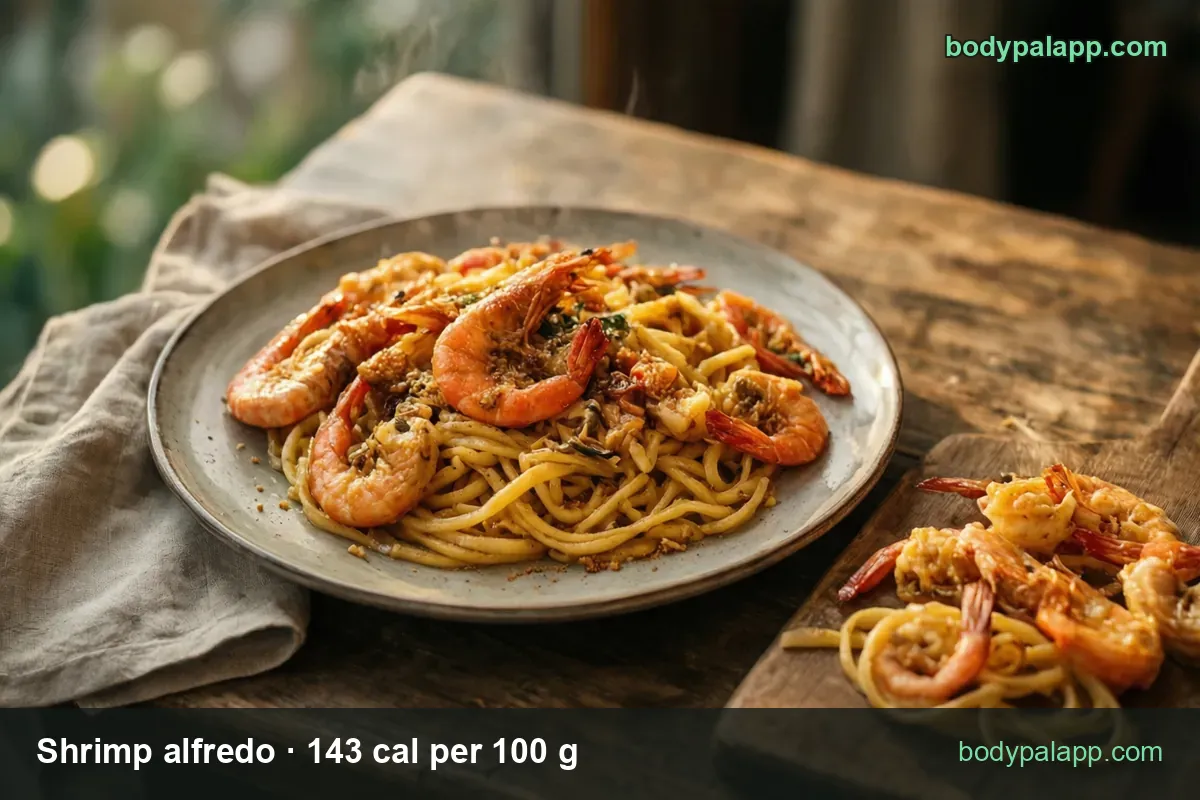
| Shrimp alfredo, homemade or restaurant style | 143 kcal | 1 cup (224 g) | 320 kcal |
| Shrimp and noodles, no sauce | 146 kcal | 100 g | 146 kcal |
| Lean Cuisine shrimp alfredo, frozen | 94 kcal | 1 package (255 g) | 240 kcal |
| Stouffer's shrimp alfredo, frozen | 128 kcal | 1 cup (211 g) | 270 kcal |
| Zatarain's shrimp alfredo bowl | 165 kcal | 1 bowl (297 g) | 490 kcal |
| Scott & Jon's shrimp alfredo with penne | 128 kcal | 1 bowl (227 g) | 291 kcal |
Here is the finding that surprises almost everyone: skipping the cream sauce does not save calories. USDA lists shrimp and noodles with no sauce at 146 calories per 100 g, three more than the same dish with cream or white sauce at 143. Pasta and the oil or butter it is tossed with already carry the load; the sauce mostly swaps one kind of fat for another rather than adding a pile of new calories. USDA does not publish a saturated fat figure for the no-sauce record, so that half of the comparison cannot be checked, but the calorie totals are clear.
The frozen aisle is genuinely lighter per gram. Lean Cuisine's shrimp alfredo with broccoli and linguine is 94 calories per 100 g, Gourmet Dining 108, Stouffer's and Scott & Jon's 128 each, Tastee Choice 150, and Zatarain's 165 — a spread of 71 calories per 100 g across six mainstream boxes. Most of them beat homemade on density because there is more vegetable and less sauce per bite.
Per package it flips. A Zatarain's bowl is 297 g and lands at 490 calories, more than a 1.5-cup restaurant plate of the real thing. The Lean Cuisine tray, at 240 calories for 255 g, is the second-lightest full meal in the group; only Gourmet Dining's smaller 194 g cup is lower, at 210 calories.
Saturated fat and cholesterol are the rows to watch
Calories are not the interesting part of this dish. A cup delivers 4.2 g of saturated fat, 21% of the Daily Value, and 125 mg of cholesterol, 42%. Scale up to the 1.5-cup plate and cholesterol reaches 188 mg, 63% of the Daily Value, from a single course.
The cholesterol comes mostly from the shrimp themselves, and current federal advice no longer sets a numeric daily cap on dietary cholesterol — the Dietary Guidelines for Americans instead ask people to keep it as low as possible while eating a healthy pattern, and to hold saturated fat under 10% of calories. On a 2,000-calorie day that is about 22 g of saturated fat; a cup of shrimp alfredo uses roughly a fifth of it.
Sodium behaves better than you would expect from a restaurant pasta. A cup is 363 mg, 16% of the Daily Value, or about a sixth of a teaspoon of table salt. Even the 1.5-cup plate comes in near 544 mg, under a quarter of the day's limit — far less than most soups or deli sandwiches. If you are watching sodium, this is not the dish to worry about.
The protein row is the quiet win: 16 g per cup, 32% of the Daily Value, from a plate that reads as pure indulgence. Shrimp counts toward the seafood servings MyPlate recommends across the week, which is more than can be said for most cream pastas.
How does shrimp alfredo compare?
| Dish | Per 100 g | Protein per 100 g | Same 224 g cup | Calories |
|---|---|---|---|---|
| Shrimp alfredo | 143 kcal | 7.14 g | 224 g | 320 kcal |
| Shrimp and noodles, no sauce | 146 kcal | 7.3 g | 224 g | 327 kcal |
| Fish, noodles and vegetables in cheese sauce | 141 kcal | 8.39 g | 224 g | 316 kcal |
| Tuna noodle casserole with mushroom sauce | 139 kcal | 9.02 g | 224 g | 311 kcal |
USDA does not publish a cup weight for the three neighbors, so we scaled all of them to the same 224 g as shrimp alfredo — our own arithmetic from each 100 g figure, not USDA servings. It is the only honest way to line them up.
Our take: choosing between seafood pasta dishes on calories is a waste of effort. All four sit within 7 calories per 100 g of each other, and the plain no-sauce version is the highest of the group, not the lowest. Where they actually differ is protein, and shrimp alfredo has the least of the four at 7.14 g per 100 g, against 9.02 g for tuna noodle casserole. If you want the most food for the calories, order what you like and control the size; if you want the most protein per calorie, the casserole wins.
Most popular shrimp alfredo brands in the United States
Ranked by how widely each product appears among foods sold in the United States, from the BodyPal food database of over 3.3 million products. Calories are the figures printed on each Nutrition Facts label, checked against USDA FoodData Central.
| Product | Calories (per 100 g) |
|---|---|
| Lean Cuisine Shrimp Alfredo | 94 cal |
| Stouffer's Family Size Shrimp Alfredo | 128 cal |
| Zatarain's Shrimp Alfredo | 165 cal |
| Tastee Choice Shrimp Alfredo | 150 cal |
| Scott & Jon's Shrimp Alfredo with Penne | 128 cal |
| Gourmet Dining Shrimp Alfredo | 108 cal |
Brand popularity: BodyPal food database. Nutrition: manufacturer labels / USDA FoodData Central.
Shrimp alfredo FAQs
How many calories are in a cup of shrimp alfredo?
320 calories for a 1-cup serving weighing 224 g, which works out to 143 calories per 100 g. That cup also brings 16 g of protein, 36.4 g of carbohydrate and 11.9 g of fat. The USDA record covers shrimp and noodles in a cream or white sauce.
How much protein is in shrimp alfredo?
16 grams of protein in a 1-cup (224 g) serving, or 32% of the Daily Value. Per 100 g the dish carries 7.14 g. Most of that comes from the shrimp, with a little from the noodles; the sauce contributes fat and calories rather than protein.
Is shrimp alfredo healthy?
A cup is 320 calories with 4.2 g of saturated fat, 21% of the Daily Value, and 363 mg of sodium, 16%. It is not a light dish, but the 16 g of protein is real. Portion size decides it: a cup fits an ordinary lunch, a 1.5-cup plate is 480.
How many calories are in a restaurant plate of shrimp alfredo?
480 calories for a 1.5-cup plate weighing 336 g, our own arithmetic from the USDA 100 g figure rather than a USDA serving. That is 160 calories more than a 1-cup portion of exactly the same food. Restaurant plates are often larger still, and cream sauces vary.
How many carbs are in shrimp alfredo?
36.4 grams of carbohydrate in a 1-cup (224 g) serving, 13% of the Daily Value, of which 1.6 g is fiber and 3.7 g is total sugars. Per 100 g that is 16.25 g of carbohydrate. The noodles carry almost all of it; shrimp bring essentially none.
How much sodium is in shrimp alfredo?
363 mg of sodium in a 1-cup serving, 16% of the Daily Value and roughly a sixth of a teaspoon of table salt. Per 100 g the figure is 162 mg. A 1.5-cup plate takes it to about 544 mg, still under a quarter of the day's limit.
How many calories are in frozen shrimp alfredo?
Between 210 and 490 calories per package, depending on the brand. Lean Cuisine's shrimp alfredo with broccoli and linguine is 240 for a 255 g package, Stouffer's 270 per cup, and a Zatarain's bowl 490 for 297 g. Per gram most frozen versions are lighter than homemade.
Does shrimp alfredo have cholesterol?
125 mg of cholesterol in a 1-cup (224 g) serving, 42% of the Daily Value, and 56 mg per 100 g. Shrimp are the reason: they are naturally high in cholesterol, and the cream sauce adds some too. A 1.5-cup plate reaches 188 mg, 63% of the Daily Value.
Similar foods
- Toor Dal — 348 cal per cup
- Lasagna — 286 cal per piece
- Shrimp Pad Thai — 294 cal per cup
- Chicken Chow Mein — 288 cal per cup
- Half And Half — 20 cal per tbsp
- Snow Cone — 256 cal per snow cone
Count it without the math
Point the camera at the plate and BodyPal counts the pasta, the sauce and the shrimp for you.


How long does it take to burn off shrimp alfredo?
A 1-cup (224 g) serving is 320 kcal. Enter your weight and the amount you ate to see how long it takes you to burn that off:
lb
| Activity | Time to burn 320 kcal |
|---|---|
| Walking, brisk | 1 hr 4 min |
| Cycling, moderate | 40 min |
| Swimming, moderate | 46 min |
| Jogging | 38 min |
| Weight training, moderate | 1 hr 11 min |
Times are for a 155 lb adult at a steady pace; change the weight to see yours. The amount is set to the portion in the text (224 g); change it to what you actually ate. BodyPal works this out from your steps automatically.
One food is easy to picture; a whole day is harder. See how many calories you need a day and what a deficit actually looks like.