
How many calories are in soba noodles?
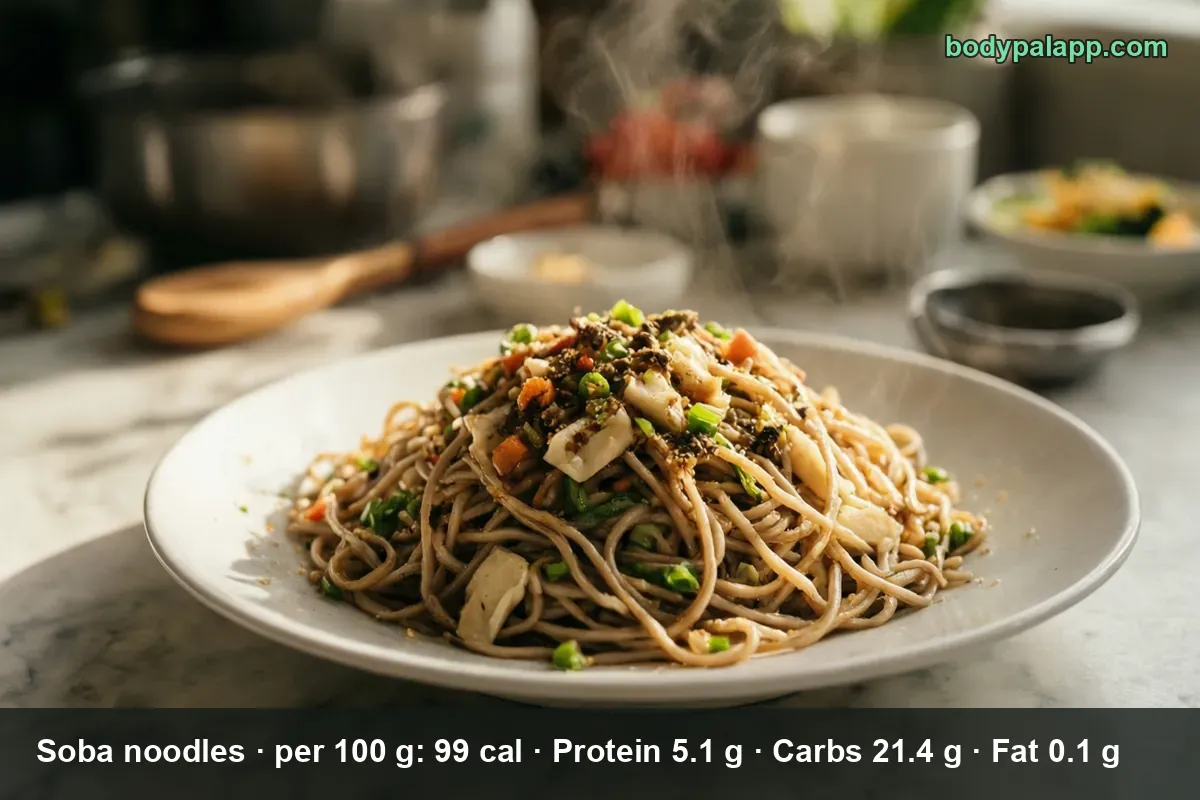
A 1-cup serving of cooked soba noodles weighs 114 g and carries 113 calories. Cooked soba runs 99 calories per 100 g. The same noodles weighed dry are 336 calories per 100 g, and that gap between the package and the bowl is where most soba counting goes wrong. Protein comes to 5.8 g a cup.
On this page
- Soba noodle quick facts
- US servings, from one ounce to a two-cup bowl
- Dry soba and the big bowl
- Sodium is the row that changes in the pot
- How do soba noodles compare?
- Most popular soba noodles brands
- FAQ
Soba noodle quick facts
The numbers below come from USDA SR Legacy record 168907, "Noodles, japanese, soba, cooked". That is the record that matches what a person actually has in front of them: a bowl of drained, boiled buckwheat noodles, hot or chilled, with or without a dipping sauce on the side. The dry record is a different food for counting purposes, and it gets its own section further down.
USDA's household measure for this record is 1 cup of cooked noodles at 114 g, so that is the serving in the column on the right.
| Nutrient | Per 100 g | Per 1 cup (114 g) | % Daily Value |
|---|---|---|---|
| Calories | 99 | 113 | — |
| Total fat | 0.1 g | 0.1 g | 0% |
| Saturated fat | 0.02 g | 0.0 g | 0% |
| Carbohydrate | 21.44 g | 24.4 g | 9% |
| Protein | 5.06 g | 5.8 g | 12% |
| Sodium | 60 mg | 68 mg | 3% |
% Daily Value is based on a 2,000-calorie diet.
Verified nutrition data
Numbers on this page come from USDA FoodData Central, the U.S. Department of Agriculture’s food composition database, and from manufacturer labels where a branded product is named. Last verified September 2026. How we verify our data →
Two rows you would expect on a Nutrition Facts panel are missing here: dietary fiber and total sugars. USDA does not publish either value for this soba record, and with no total sugars figure there is no honest added sugars line either, so all three stay off the table rather than being guessed. Cholesterol is 0 mg, as it is in any flour-and-water noodle, and potassium is 35 mg per 100 g, or 40 mg in a cup, which is 1% of the Daily Value.
The Daily Values used in the last column are the FDA reference amounts for adults and children over four, published on the FDA's Daily Value page.
US servings, from one ounce to a two-cup bowl
| Serving | Weight | Calories |
|---|---|---|
| 1 oz cooked | 28 g | 28 kcal |
| 1/2 cup cooked | 57 g | 56 kcal |
| 4 oz cooked | 113 g | 112 kcal |
| One cup cooked | 114 g | 113 kcal |
| Two cups, a full dinner bowl | 228 g | 226 kcal |
| Per 100 g cooked | 100 g | 99 kcal |
Only the 1-cup line is a USDA household measure. The ounce rows, the half cup and the two-cup bowl are our own arithmetic from the USDA 100 g figure, not USDA servings.
Notice how close 4 oz and 1 cup land: 113 g against 114 g, one calorie apart. A drained cup of soba lands at almost exactly 4 ounces on a scale, which is unusual and convenient. It means a kitchen scale and a measuring cup will give you the same answer for this food, which is not true of rice, oatmeal or short pasta shapes.
The trap is the other direction. A cup of dry soba is not a thing anyone measures, because dry soba comes in banded bundles, not loose strands. Packages sell it by the ounce, and every calorie count on the back of the box refers to that dry weight.
Dry soba and the big bowl
| Version | Per 100 g | Typical portion | Calories |
|---|---|---|---|
| Cooked soba, drained | 99 kcal | 1 cup, 114 g | 113 kcal |
| Dry soba, straight from the bundle | 336 kcal | 2 oz, 57 g | 192 kcal |
| Cooked soba, big bowl | 99 kcal | 2 cups, 228 g | 226 kcal |
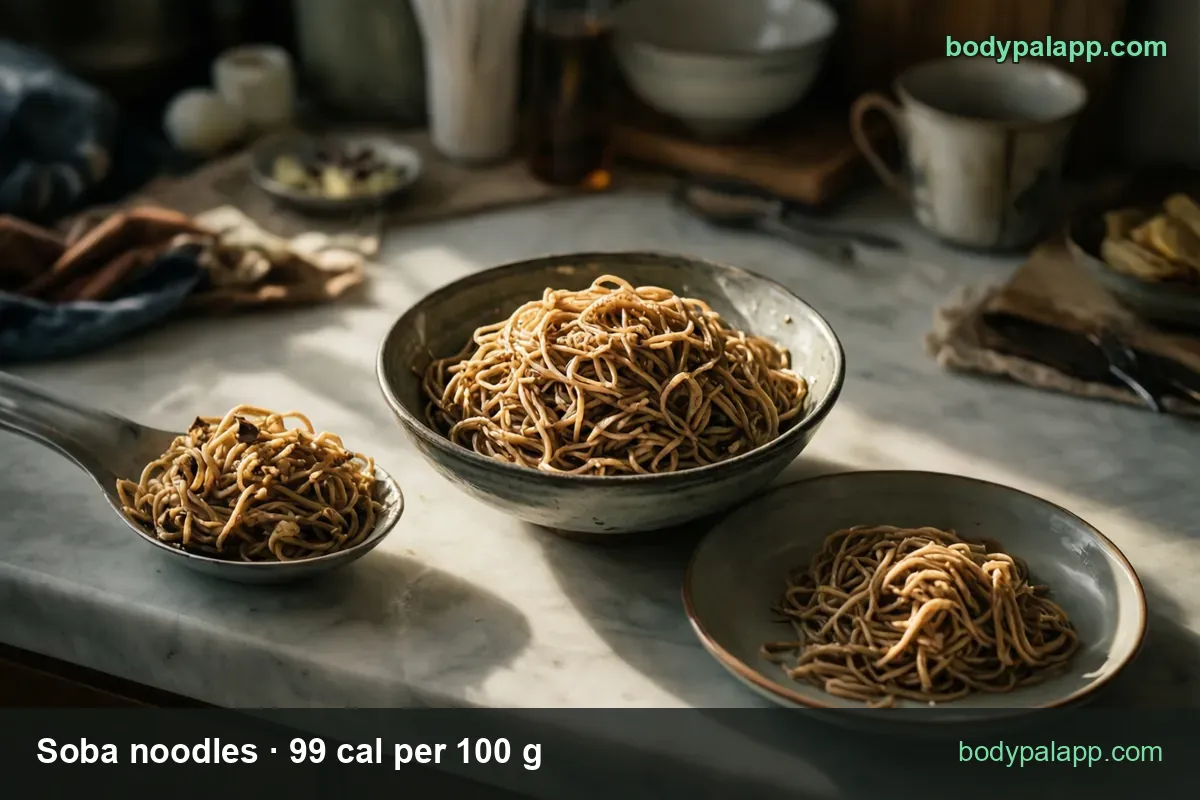
Dry soba, USDA record 168906, is 336 calories per 100 g against 99 for the cooked record. That is not two different noodles. It is the same noodle before and after it absorbs water, and the whole difference is weight the noodle picks up in the pot.
Run the arithmetic and the two sides meet. A 2 oz (57 g) bundle is 192 calories dry. Those calories do not change in the water, so the cooked noodles that come out still carry 192 calories, and at 99 calories per 100 g they weigh about 194 g, roughly 1.7 cups. That is our own scaling from the USDA figures, not a USDA serving, but it is the number worth remembering: a single 2 oz bundle makes a generous bowl.
The dry side also has a protein figure worth flagging. A 2 oz bundle carries 8.2 g of protein and 42.5 g of carbohydrate, which is 16% and 15% of the Daily Value in the same portion.
Retail packages track the dry USDA record closely. Simply Asia lists 339 calories per 100 g and 190 for its 2 oz dry serving; Blue Dragon and Signature Select both list 357 per 100 g and 200 per 2 oz. Annie Chun's sells a ready-cooked 170 g pack at 147 calories per 100 g, or 250 for the pack, which is higher per gram than plain boiled soba because the noodles are packed with seasoning rather than drained plain.
Sodium is the row that changes in the pot
Here is the thing almost nobody tells you about soba. Dry soba carries 792 mg of sodium per 100 g — 34% of the Daily Value in 100 g of dry noodles, or 451 mg (20% DV) in a single 2 oz bundle, about a fifth of a teaspoon of table salt. Salt is worked into the dough to hold buckwheat together, since buckwheat has no gluten of its own.
Cooked soba is 60 mg per 100 g. A cup is 68 mg, 3% of the Daily Value.
Most of the salt leaves with the cooking water. If you have been logging soba from the package panel and then eating it boiled and drained, you have been counting sodium that went down the sink. The FDA's daily limit reference is 2,300 mg, and the Dietary Guidelines for Americans treat that as the ceiling for adults, so a 68 mg bowl of noodles is close to a rounding error against it. The dipping sauce is a different story — tsuyu, soy sauce and miso broth all bring their own sodium, and those belong in your log separately.
The other row that flatters soba is protein. A cup gives 5.8 g, 12% of the Daily Value, against 9% for carbohydrate in the same bowl. For a noodle, that ratio is unusual. Buckwheat is counted as a whole grain by MyPlate when the noodles are made from whole buckwheat flour, though most US soba blends buckwheat with wheat flour, and the package ingredient list is the only way to tell how much of each you are getting.
How do soba noodles compare?
Cooked soba is hard to compare with anything on a shelf, because everything on a shelf is dry. So this table shows both sides of soba next to the dry grains USDA files near it.
| Food | Per 100 g | US serving | Calories |
|---|---|---|---|
| Soba noodles, cooked | 99 kcal | 1 cup, 114 g | 113 kcal |
| Soba noodles, dry | 336 kcal | 2 oz, 57 g | 192 kcal |
| Buckwheat flour, whole-groat | 335 kcal | 2 oz, 57 g | 191 kcal |
| Triticale | 336 kcal | 2 oz, 57 g | 192 kcal |
| Rye grain | 338 kcal | 2 oz, 57 g | 193 kcal |
Our take: the three dry grains sit within 3 calories of each other per 100 g, and dry soba sits right in the middle of them at 336 — flour, grain and noodle are all about the same food by weight. Cooked soba, at 99, is less than a third of any of them per gram, and that is entirely water. So pick your unit and stick to it. If you are watching calories, weigh soba after cooking and use 99 per 100 g; if you are portioning before you cook, count the bundle at 2 oz and 192 calories and forget the bowl weight entirely. Mixing the two is how a 200-calorie dinner turns into a 650-calorie entry.
Most popular soba noodles brands in the United States
Ranked by how widely each product appears among foods sold in the United States, from the BodyPal food database of over 3.3 million products. Calories are the figures printed on each Nutrition Facts label, checked against USDA FoodData Central.
| Product | Calories (per 100 g) |
|---|---|
| Simply Asia Japanese Style Soba Noodles | 339 cal |
| Blue Dragon Soba Noodles | 357 cal |
| Signature Select Japanese-Style Soba Noodles | 357 cal |
| Annie Chun's Organic Buckwheat Soba Noodles | 147 cal |
Brand popularity: BodyPal food database. Nutrition: manufacturer labels / USDA FoodData Central.
Soba noodle FAQs
How many calories are in a cup of soba noodles?
113 calories in one cup of cooked soba noodles, which USDA weighs at 114 g. That works out to 99 calories per 100 g. The same cup carries 5.8 g of protein, 24.4 g of carbohydrate, almost no fat at 0.1 g, and 68 mg of sodium.
How many calories in 2 oz of dry soba noodles?
192 calories in a 2 oz (57 g) bundle of dry soba, scaled from USDA's 336 calories per 100 g for uncooked soba. That is the number printed on most US packages, and it is also the calorie count of the finished bowl, since boiling adds water but no calories.
How much does 2 oz of dry soba weigh after cooking?
About 194 g, roughly 1.7 cups. A 57 g dry bundle is 192 calories, and cooked soba is 99 calories per 100 g, so those same calories spread across about 194 g of drained noodles. That is our own arithmetic from the two USDA records, not a USDA serving.
How much protein is in soba noodles?
5.8 g of protein in a 1-cup (114 g) serving of cooked soba, or 5.06 g per 100 g. That is 12% of the Daily Value, against 9% for carbohydrate in the same bowl. A 2 oz dry bundle, before cooking, carries 8.2 g, which is 16% of the Daily Value.
How many carbs are in soba noodles?
24.4 g of carbohydrate in a cup of cooked soba (114 g), or 21.44 g per 100 g, which is 9% of the Daily Value. Two cups double it to 48.9 g. USDA does not publish a fiber or sugar breakdown for this record, so the net-carb math cannot be done honestly here.
Why are soba noodles so high in sodium?
Dry soba carries 792 mg of sodium per 100 g, 34% of the Daily Value, because salt is worked into the dough to bind buckwheat, which has no gluten. Most of it leaves with the cooking water: drained soba is 60 mg per 100 g, and a cup only 68 mg.
Are soba noodles gluten free?
Not reliably, even though the 99-calorie USDA record is built on buckwheat, which contains no gluten. Most soba sold in US stores blends buckwheat with wheat flour for texture, and the ratio varies by brand. The ingredient list on the package is the only way to know which one you have.
Are soba noodles good for weight loss?
At 113 calories a cup, soba is a light base for a meal, and 5.8 g of protein a cup is high for a noodle. If you are counting, weigh the noodles cooked at 99 calories per 100 g. The sauce and toppings usually decide the total, not the soba.
Similar foods
- Wild Rice — 166 cal per cup, cooked
- Quinoa — 222 cal per cup cooked
- Rice — 205 cal per cup, cooked
- Milk — 149 cal per cup
- Pasta — 168 cal per cup penne
- Penne pasta — 169 cal per cup
Count it without the math
Point the camera at the bowl and BodyPal counts the soba for you, cooked weight and all.


How long does it take to burn off soba Noodles?
A 1-cup (114 g) serving is 113 kcal. Enter your weight and the amount you ate to see how long it takes you to burn that off:
lb
| Activity | Time to burn 113 kcal |
|---|---|
| Walking, brisk | 23 min |
| Cycling, moderate | 14 min |
| Swimming, moderate | 16 min |
| Jogging | 13 min |
| Weight training, moderate | 25 min |
Times are for a 155 lb adult at a steady pace; change the weight to see yours. The amount is set to the portion in the text (114 g); change it to what you actually ate. BodyPal works this out from your steps automatically.
This table assumes you know your daily total. If you do not, the daily calorie calculator works it out from five numbers.