
How many calories are in spaghetti noodles?
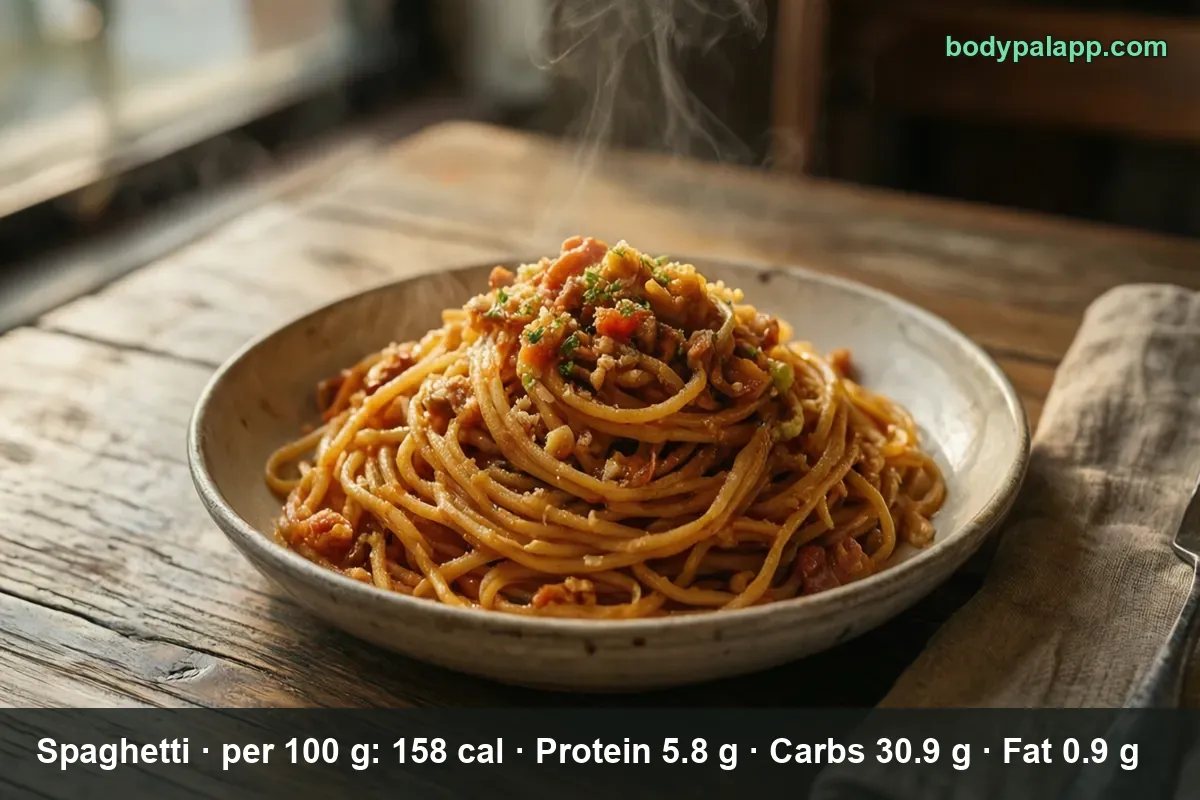
A 1-cup serving of cooked spaghetti, not packed, is 196 calories — 124 g of drained noodles at 158 calories per 100 g. Dry, the same pasta runs 371 per 100 g, so the 2 oz you snap off the box is 211 before a drop of sauce. Water changes the weight, not the count.
On this page
- Spaghetti quick facts
- US servings, from one ounce to a packed cup
- Dry, salted, spinach and protein-fortified spaghetti
- Carbs, fiber and the sodium the water adds
- How does spaghetti compare?
- Most popular spaghetti noodles brands
- FAQ
Spaghetti quick facts
The number most people want is the one on the plate, not the one in the box, so the row behind this page is SR Legacy 169737, "Pasta, cooked, enriched, without added salt". USDA files long strand pasta under the generic "pasta" heading in that database — spaghetti, linguine and vermicelli all share it once they are boiled — and the unsalted version is the clean baseline: plain water, nothing else in the pot.
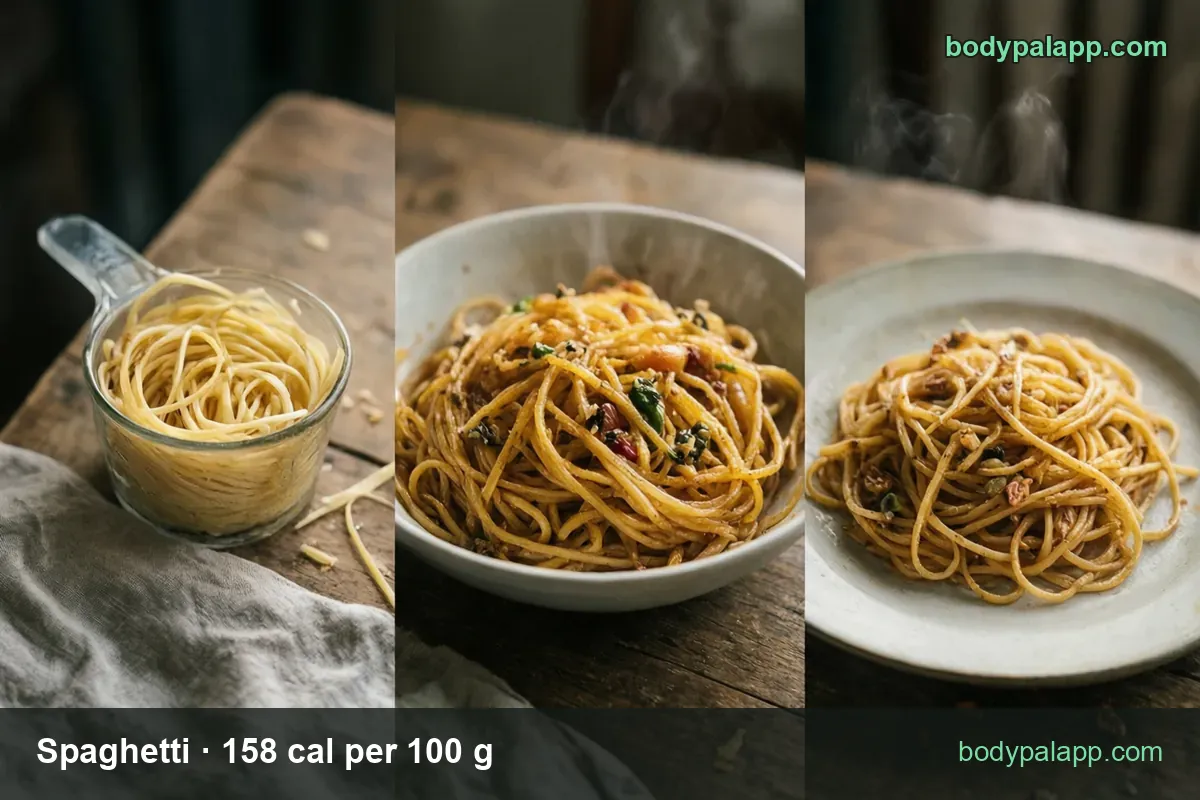
Its household measure is one cup of spaghetti, not packed, at 124 g. That is a loosely twirled cup, the way noodles fall off a fork into a measuring cup rather than being pressed down with a spoon.
| Nutrient | Per 100 g | Per 1 cup (124 g) | % Daily Value |
|---|---|---|---|
| Calories | 158 | 196 | — |
| Total fat | 0.93 g | 1.2 g | 1% |
| Saturated fat | 0.18 g | 0.2 g | 1% |
| Carbohydrate | 30.86 g | 38.3 g | 14% |
| Dietary fiber | 1.8 g | 2.2 g | 8% |
| Total sugars | 0.56 g | 0.7 g | — |
| Protein | 5.8 g | 7.2 g | 14% |
| Sodium | 1 mg | 1 mg | 0% |
% Daily Value is based on a 2,000-calorie diet.
Verified nutrition data
Numbers on this page come from USDA FoodData Central, the U.S. Department of Agriculture’s food composition database, and from manufacturer labels where a branded product is named. Last verified September 2026. How we verify our data →
There is no added sugars line in the table because SR Legacy does not publish added sugars for this record — and plain boiled noodles have none anyway; the 0.56 g of total sugars per 100 g comes from the wheat itself. Cholesterol is 0 mg, as you would expect from flour and water, and a cup carries 55 mg of potassium, about 1% of the 4,700 mg Daily Value.
US servings, from one ounce to a packed cup
| Serving | Weight | Calories |
|---|---|---|
| 1 oz cooked | 28 g | 44 kcal |
| 1 cup spaghetti, not packed | 124 g | 196 kcal |
| 1 cup spaghetti, packed | 151 g | 239 kcal |
| 1 cup penne | 107 g | 169 kcal |
| Per 100 g | 100 g | 158 kcal |
The two cup rows are both USDA household measures for the same record, and the gap between them is the single most useful thing on this page. A loose cup is 124 g and 196 calories. Press the same noodles into the same cup and you get 151 g and 239 calories — 43 calories of difference for identical words on a log. If you eat pasta a few nights a week and you always measure by cup, that drift adds up faster than any topping you are worried about.
The shape matters too, for the same reason: a cup of penne holds only 107 g of cooked pasta because the tubes trap air, so it comes in at 169 calories. Long strands pack denser than short shapes. The 1 oz row is our own arithmetic from the USDA 100 g figure, not a USDA serving — handy if you weigh leftovers rather than measure them.
Dry, salted, spinach and protein-fortified spaghetti
| Version | Per 100 g | Typical serving | Calories |
|---|---|---|---|
| Cooked, unsalted water (this page) | 158 kcal | 1 cup (124 g) | 196 kcal |
| Cooked in salted water | 157 kcal | 1 cup (124 g) | 195 kcal |
| Dry, enriched | 371 kcal | 2 oz (57 g) | 211 kcal |
| Spinach spaghetti, cooked | 130 kcal | 1 cup (124 g) | 161 kcal |
| Protein-fortified, cooked | 164 kcal | 1 cup (124 g) | 203 kcal |
| Spaghetti squash, cooked | 27 kcal | 1 cup (124 g) | 33 kcal |
Dry versus cooked is where most logs go wrong. Dry spaghetti is 371 calories per 100 g — more than double the cooked figure — not because it is a different food but because it is the same food with the water taken out. Break off 2 oz, boil it, and you get roughly one loose cup on the plate. The strands more than double in weight and the calories stay put, because water has none.
Box labels tell that story in slightly different numbers. Barilla, De Cecco, Mueller's and San Giorgio all print 200 calories for a 2 oz (56 g) dry serving, and Garofalo's No. 9 prints 210 for the same 56 g, sitting at 375 per 100 g against the 357 the others declare. USDA's generic dry row gives 211 for a 57 g pair of ounces. Labels round; the database does not. Either way, one dry ounce of any brand of spaghetti is roughly 100 calories, which is the easiest kitchen rule on this page.
The last three cup figures in the table — spinach, protein-fortified and squash — are our own arithmetic from each USDA 100 g figure, since USDA lists no cup measure for them. Spinach spaghetti is not a diet product; it is 130 calories per 100 g and 161 a cup's worth mostly because the cooked noodles hold more water, and its dry form is nearly identical to plain dry pasta. Protein-fortified spaghetti is the outlier in the other direction: 164 calories per 100 g cooked, more than the plain row, in exchange for 8.86 g of protein per 100 g instead of 5.8 g.
Carbs, fiber and the sodium the water adds
A cup of spaghetti delivers 38.3 g of carbohydrate, 14% of the 275 g Daily Value. That is real, and it is also less dramatic than pasta's reputation suggests — a seventh of the day, for a plateful of food. The protein line lands at exactly the same 14%: 7.2 g against a 50 g Daily Value, which is more than most people expect from a bowl of noodles.
Fiber is the weak spot. Enriched white spaghetti gives 2.2 g a cup, 8% DV, so three cups would still leave you short of the 28 g target. MyPlate asks that at least half your grains be whole grains, and pasta night is the easy place to make that trade — the Dietary Guidelines put the same emphasis on grain quality rather than grain avoidance.
Then there is the pot. Boiling in salted water moves sodium from 1 mg per 100 g to 131 mg — 162 mg in a cup, about 7% of the 2,300 mg Daily Value, or roughly a fifteenth of a teaspoon of table salt landing in the noodles. Calories barely register the change: 157 per 100 g salted against 158 unsalted, a rounding artifact rather than a real difference. If you are watching sodium, the salt in the water is worth counting; if you are watching calories, it is not.
How does spaghetti compare?
| Food | Per 100 g | US serving | Calories |
|---|---|---|---|
| Spaghetti, cooked | 158 kcal | 1 cup (124 g) | 196 kcal |
| Spinach spaghetti, cooked | 130 kcal | 1 cup (124 g) | 161 kcal |
| Protein-fortified spaghetti, cooked | 164 kcal | 1 cup (124 g) | 203 kcal |
| Spaghetti squash, cooked | 27 kcal | 1 cup (124 g) | 33 kcal |
Our take: the three wheat rows are within 42 calories of each other per cup, so swapping spinach pasta for regular pasta is a flavor decision, not a weight-loss one. If the goal is a lighter plate, spaghetti squash is the only row here that actually changes the math — 27 calories per 100 g, the lowest of the four by a wide margin, and 33 calories for a cup against 196. If the goal is staying full, do the opposite and take the protein-fortified row: 203 calories a cup buys about 11 g of protein instead of 7.2 g, and protein is what keeps a pasta dinner from turning into a 10 p.m. snack. Plain enriched spaghetti sits sensibly in the middle, and portion control beats product swaps every time here.
Most popular spaghetti noodles brands in the United States
Ranked by how widely each product appears among foods sold in the United States, from the BodyPal food database of over 3.3 million products. Calories are the figures printed on each Nutrition Facts label, checked against USDA FoodData Central.
| Product | Calories (per 100 g) |
|---|---|
| Barilla Spaghetti | 357 cal |
| Barilla Spaghetti N5 | 357 cal |
| Garofalo Spaghetti No. 9 | 375 cal |
| De Cecco Spaghetti No. 12 | 357 cal |
| Mueller's Thin Spaghetti | 357 cal |
| San Giorgio Spaghetti No. 8 | 357 cal |
Brand popularity: BodyPal food database. Nutrition: manufacturer labels / USDA FoodData Central.
Spaghetti noodle FAQs
How many calories are in a cup of spaghetti noodles?
A 1-cup serving of cooked spaghetti, not packed, weighs 124 g and carries 196 calories, at 158 calories per 100 g. That is USDA's own household measure for the enriched pasta row. Pack the same cup tighter and it holds 151 g and 239 calories — the same words on a log, 43 more calories.
How many calories in 2 oz of dry spaghetti?
Two ounces of dry spaghetti is 211 calories, using USDA's dry enriched pasta row at 371 calories per 100 g and 57 g for the pair of ounces. Most box labels print 200 calories instead, because they define the serving as 56 g and round the result. Both describe the same handful of noodles.
How much does 2 oz of dry spaghetti weigh cooked?
Two ounces of dry spaghetti, 56 to 57 g, comes out of the pot at roughly 124 g — about one loose cup. The weight more than doubles because the strands drink water, but the calories do not move, since water contributes none. Weigh pasta dry when you can; it is the more stable number.
Is spaghetti high in carbs?
A cup has 38.3 g of carbohydrate, 14% of the 275 g Daily Value, from 30.86 g per 100 g cooked. So yes, it is a carbohydrate food by design — but one cup is about a seventh of a day's carbs, not a blowout. Fiber accounts for 2.2 g of that cup.
How much protein is in spaghetti noodles?
A 1-cup serving has 7.2 g of protein, 14% of the 50 g Daily Value, from 5.8 g per 100 g. Protein-fortified spaghetti raises that to 8.86 g per 100 g, about 11 g a cup. Wheat protein is not complete on its own, so pair the plate with beans, meat, eggs or cheese.
Does salting the water add calories to pasta?
No — salted water adds 0 calories. It adds sodium: USDA's salted row runs 131 mg per 100 g against 1 mg unsalted, so a 124 g cup goes from 1 mg to 162 mg, about 7% of the 2,300 mg Daily Value. Calories stay at 157 to 158 per 100 g either way.
Is spaghetti squash a good swap for spaghetti noodles?
A cup of cooked spaghetti squash — 124 g, our own arithmetic from the USDA 100 g figure — is 33 calories against 196 for the same cup of pasta. It is a vegetable, not a noodle: 6.46 g of carbohydrate and 0.66 g of protein per 100 g, so it fills the plate without filling you.
How many calories in a plate of spaghetti with sauce?
The noodles alone are 196 calories a cup, and that is all this page covers. Sauce, oil, cheese and meat are separate numbers, because the USDA record behind these figures — Pasta, cooked, enriched, without added salt — contains none of them. Weigh the sauce and log it as its own line.
Similar foods
- Penne pasta — 169 cal per cup
- Pasta — 168 cal per cup penne
- Baba ganoush — 110 cal for 1/4 cup
- Rice — 205 cal per cup, cooked
- Prosciutto — 55 cal for 3 thin slices
- Quinoa — 222 cal per cup cooked
Count it without the math
Point the camera at the plate and BodyPal counts the spaghetti for you, cup or packed cup.


How long does it take to burn off 196 kcal of spaghetti Noodle?
A 1-cup (124 g) cooked serving is 196 kcal. Enter your weight and the amount you ate to see how long it takes you to burn that off:
lb
| Activity | Time to burn 196 kcal |
|---|---|
| Walking, brisk | 39 min |
| Cycling, moderate | 24 min |
| Swimming, moderate | 28 min |
| Jogging | 23 min |
| Weight training, moderate | 44 min |
Times are for a 155 lb adult at a steady pace; change the weight to see yours. The amount is set to the portion in the text (124 g); change it to what you actually ate. BodyPal works this out from your steps automatically.
Want the bigger picture? Calculate your daily calorie needs — your maintenance figure, a target for losing or gaining, and the date you get there.