
How many calories are in a strip steak?
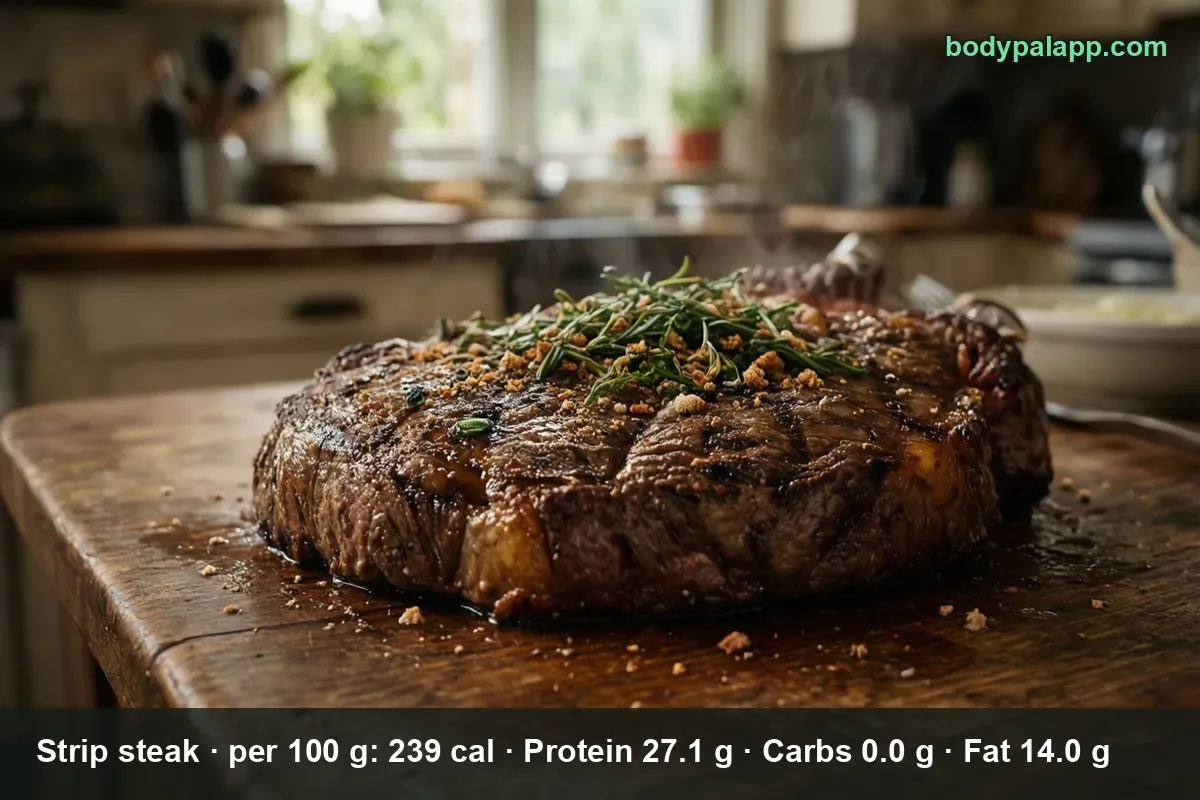
A regular strip steak off the grill weighs 240 g and carries 574 calories. Per 100 g the cooked meat runs 239 calories, most of it protein and fat, none of it carbohydrate. Trim the fat cap on the plate and the same steak drops to 518. Slice it thin and one piece is 72.
On this page
- Strip steak quick facts
- US servings, from one ounce to a whole thick steak
- Trimmed, untrimmed, raw and grass-fed
- Saturated fat and sodium are the rows to watch
- How does strip steak compare?
- Most popular strip steak brands
- FAQ
Strip steak quick facts
The row behind every number on this page is FNDDS 2705835, "Beef, steak, strip, NS as to fat eaten". "NS as to fat" means the record does not specify whether the diner ate the fat cap or left it on the plate, which is exactly how a steak arrives at a table. It is cooked, it is described in whole-steak household portions, and it is the record that matches a plate rather than a butcher's case.
The raw records are a different question. They describe the meat before it loses water on the grill, so their per-gram numbers are lower and their weights are higher. Those get their own section further down.
| Nutrient | Per 100 g | Per 1 regular steak (240 g) | % Daily Value |
|---|---|---|---|
| Calories | 239 | 574 | — |
| Total fat | 13.98 g | 33.6 g | 43% |
| Saturated fat | 5.45 g | 13.1 g | 65% |
| Carbohydrate | 0 g | 0 g | 0% |
| Dietary fiber | 0 g | 0 g | 0% |
| Total sugars | 0 g | 0 g | — |
| Protein | 27.14 g | 65.1 g | 130% |
| Sodium | 361 mg | 866 mg | 38% |
% Daily Value is based on a 2,000-calorie diet.
Verified nutrition data
Numbers on this page come from USDA FoodData Central, the U.S. Department of Agriculture’s food composition database, and from manufacturer labels where a branded product is named. Last verified September 2026. How we verify our data →
Two label lines are missing on purpose. USDA does not publish added sugars or trans fat for this FNDDS record, so neither row appears here; plain beef with no breading and no sauce carries no added sugar anyway. Cholesterol and potassium do appear in the record: 85 mg and 315 mg per 100 g, which works out to 204 mg of cholesterol (68% DV) and 756 mg of potassium (16% DV) in the 240 g steak.
US servings, from one ounce to a whole thick steak
| Serving | Weight | Calories |
|---|---|---|
| 1 oz | 28 g | 67 kcal |
| One slice or piece, any size | 30 g | 72 kcal |
| Per 100 g | 100 g | 239 kcal |
| 1 cup, diced | 135 g | 323 kcal |
| One thin steak | 180 g | 430 kcal |
| One regular steak | 240 g | 574 kcal |
| One thick steak | 360 g | 860 kcal |
Five of those are USDA household measures for this record: the thin, regular and thick steaks, the single slice, and the cup of diced meat. The 1 oz line is our own arithmetic from the USDA 100 g figure, not a USDA serving, and it is the handiest number to memorize — 67 calories an ounce, cooked.
The spread between a thin steak and a thick one is 430 calories, which is more than most people budget for a whole side dish. A restaurant steak described as 12 oz on the menu is a raw weight, so it lands somewhere between the regular and thick rows once it has been cooked and rested.
Trimmed, untrimmed, raw and grass-fed
| Version | Per 100 g | Typical serving | Calories |
|---|---|---|---|
| Lean only eaten, fat cap left | 216 kcal | one regular steak (240 g) | 518 kcal |
| Lean and fat eaten | 262 kcal | one regular steak (240 g) | 629 kcal |
| NY strip (short loin), raw | 190 kcal | 4 oz (113 g) | 215 kcal |
| Grass-fed, lean only, raw | 117 kcal | 4 oz (113 g) | 132 kcal |
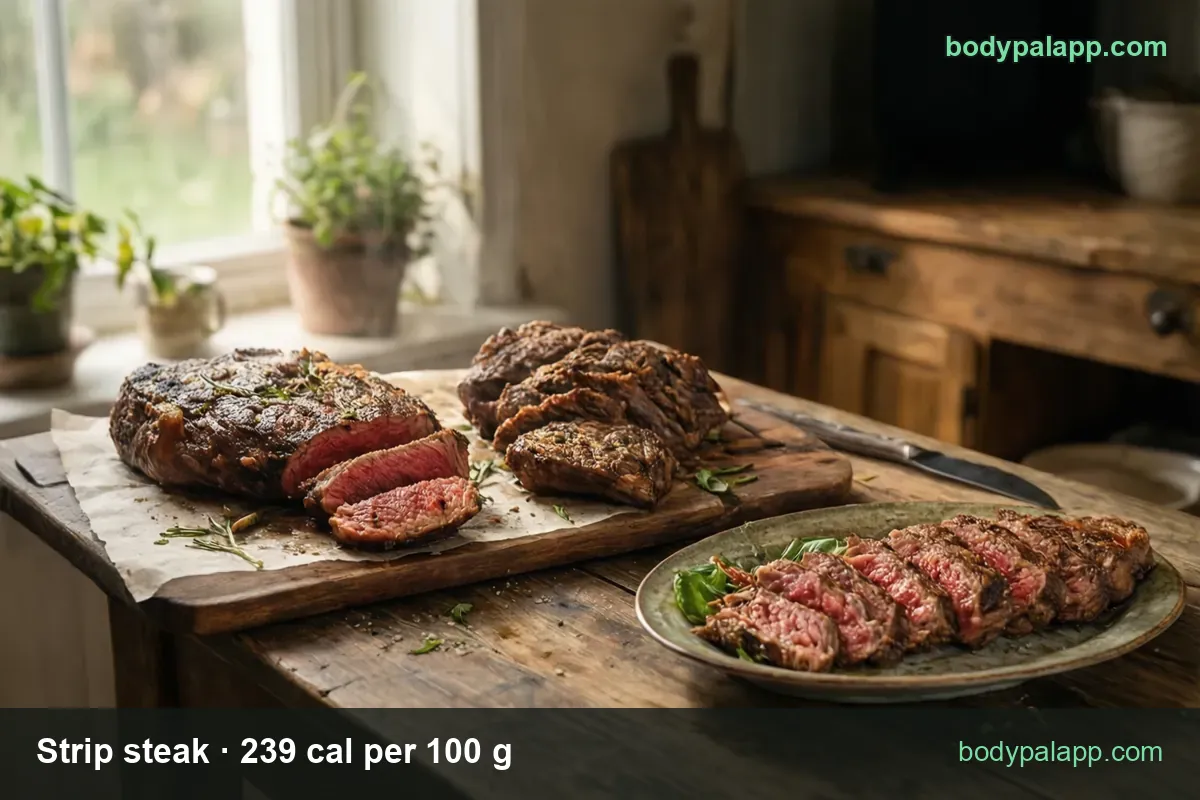
| Sliced, cooked | 239 kcal | one slice (30 g) | 72 kcal |
| Diced, cooked | 239 kcal | 1 cup (135 g) | 323 kcal |
The fat cap is the biggest single decision on the plate. Eating it puts the steak at 262 calories per 100 g; leaving it puts the same cut at 216. Across a 240 g steak that is 111 calories, which is roughly a pat and a half of butter you never ordered.
Raw and cooked are not interchangeable. The Foundation record for raw NY strip short loin is 190 calories per 100 g against 239 for the cooked record, because the grill drives off water and concentrates what is left. A 113 g raw steak comes off the heat closer to 85 g, and 85 g of the cooked record is about 203 calories by our own arithmetic from the USDA 100 g figure — near enough to the 215 the raw steak started with. The calories stay put; the grams do not. That is why the "4 oz" printed on a package is never 4 oz on the plate.
Grass-fed is the outlier, and the label needs reading carefully. The SR Legacy grass-fed record is 117 calories per 100 g, but it is both raw and trimmed to lean only, so two things are pulling the number down at once. It is not evidence that grass-fed beef is half the calories of grain-fed once both are cooked.
Packaged retail steaks tell the same raw-weight story. US branded strip steaks label between 113 and 232 calories per 100 g, all of them raw pack values, which is why they read lower than the 239 of a cooked steak rather than higher.
Saturated fat and sodium are the rows to watch
One regular steak covers 130% of the Daily Value for protein, and that is the headline most people want. The rows underneath deserve equal attention: 65% DV for saturated fat and 68% DV for cholesterol from a single steak, using the FDA's Daily Values for the Nutrition Facts label. The Dietary Guidelines put saturated fat below 10% of daily calories, and 13.1 g is most of that allowance on a 2,000-calorie day.
Sodium is the surprise. At 866 mg the steak is 38% of a day's DV — a little over a third of a teaspoon of table salt. Almost none of that comes from the animal: the raw grass-fed record is 55 mg per 100 g and the raw short loin record is 43 mg, against 361 mg once cooked. The salt is seasoning, which means it is the one number on the label you control completely.
If you are watching saturated fat, ordering the same steak and leaving the fat cap is the cheapest fix available: 518 calories instead of 629, and a saturated fat row that falls with it. If you are watching sodium, season lighter and skip the finishing salt.
How does strip steak compare?
| Cut | Per 100 g | US serving | Calories |
|---|---|---|---|
| Strip steak, cooked | 239 kcal | one regular steak, 240 g | 574 kcal |
| Top round steak, lean only, raw | 116 kcal | 4 oz (113 g) | 131 kcal |
| Mock tender steak, lean only, raw | 117 kcal | 4 oz (113 g) | 132 kcal |
| Eye of round steak, lean only, raw | 116 kcal | 4 oz (113 g) | 131 kcal |
Read that table with one caveat in mind: the three comparison cuts are raw and trimmed to lean only, the only form USDA publishes for them, while the strip steak row is cooked. Top round and eye of round tie at 116 calories per 100 g and mock tender sits at 117, so all three are within one calorie of each other before cooking.
Our take: strip steak is a protein-dense cut that is easy to over-order, not a cut you need to avoid. The 240 g steak is a legitimate 574-calorie main course with 65 g of protein, and it fits a normal day if the sides are modest. If you want the same protein for less, the round cuts are genuinely leaner meat and not just leaner records — trimmed round runs 2.45 g of fat per 100 g raw against 16.65 g for strip eaten with the fat cap. If you want the strip, order it and leave the fat cap: that single decision is worth more than switching cuts and losing the flavor you paid for.
Most popular strip steak brands in the United States
Ranked by how widely each product appears among foods sold in the United States, from the BodyPal food database of over 3.3 million products. Calories are the figures printed on each Nutrition Facts label, checked against USDA FoodData Central.
| Product | Calories (per 100 g) |
|---|---|
| Stampede Boneless Beef New York Strip Steak | 113 cal |
| Sutton & Dodge Strip Steak Choice Angus Beef | 211 cal |
| Simple Truth Beef Strip Steak | 196 cal |
| PRE New York Beef Strip Steak | 195 cal |
| Strauss Boneless Strip Steak | 223 cal |
| Organic Prairie Beef New York Strip Steak | 232 cal |
Brand popularity: BodyPal food database. Nutrition: manufacturer labels / USDA FoodData Central.
Strip steak FAQs
How many calories are in an 8 oz strip steak?
About 542 calories for 8 oz (227 g) of cooked strip steak, scaled from the USDA figure of 239 calories per 100 g. That is our own arithmetic, not a USDA serving. If the 8 oz is the raw weight on the package, expect roughly 6 oz on the plate once it has cooked and rested.
How many calories in a 12 oz strip steak?
About 813 calories for 12 oz (340 g) cooked, our own arithmetic from the USDA 100 g figure of 239 calories. USDA's own household measure for a thick steak is 360 g at 860 calories, which is the closest published match. Menu weights are raw weights, so a 12 oz order lands between those two.
Is strip steak the same as New York strip?
Yes — same cut, different names, and 239 calories per 100 g cooked either way. USDA files the raw version as beef short loin, NY strip steak, and the cooked version simply as strip steak. Kansas City strip and shell steak are the same muscle again. Nutritionally the label you use makes no difference.
How much protein is in a strip steak?
A 240 g regular steak carries 65.1 g of protein, which is 130% of the Daily Value on the Nutrition Facts label. Per 100 g that is 27.14 g. Even a single 30 g slice contributes about 8 g. Strip steak is one of the densest protein sources you can put on a plate without supplements.
Does trimming the fat cap cut calories?
It cuts 111 calories from a 240 g steak. USDA publishes both cases: lean only eaten is 216 calories per 100 g and 518 for the steak, lean and fat eaten is 262 per 100 g and 629. Saturated fat falls with it, from 6.56 g to 4.35 g per 100 g.
Do raw and cooked strip steak calories differ?
Per 100 g, yes: 190 calories raw against 239 cooked. Nothing is added on the grill — water leaves, so the same calories sit in fewer grams. A 113 g raw steak finishes around 85 g. Weigh raw or weigh cooked, but do not mix a raw weight with a cooked per-gram number.
How many calories in strip steak per ounce?
67 calories per cooked ounce (28 g), scaled from USDA's 239 calories per 100 g — our own arithmetic rather than a published serving. A thin steak of 180 g is 430 calories and a single slice of 30 g is 72, so the per-ounce figure is the fastest way to price an odd cut.
Is strip steak good for weight loss?
It works if you control the size: a trimmed 180 g steak is about 389 calories by our own arithmetic from the 216 per 100 g lean-only record, with roughly 50 g of protein — a strong ratio. The problem is never the cut, it is the 360 g steak at 860 calories.
Similar foods
- Steak — 368 cal per regular steak
- Eggnog — 112 cal for 1/2 cup
- Protein Shake — 156 cal per cup
- Bubble Tea — 239 cal per drink
- Apple cider — 114 cal per cup
- Root beer — 152 cal for 12 fl oz glass
Count it without the math
Point the camera at the plate and BodyPal counts the steak for you, fat cap and all.


How long does it take to burn off strip steak?
One regular steak (240 g) is 574 kcal. Enter your weight and the amount you ate to see how long it takes you to burn that off:
lb
| Activity | Time to burn 574 kcal |
|---|---|
| Walking, brisk | 1 hr 55 min |
| Cycling, moderate | 1 hr 12 min |
| Swimming, moderate | 1 hr 22 min |
| Jogging | 1 hr 8 min |
| Weight training, moderate | 2 hr 8 min |
Times are for a 155 lb adult at a steady pace; change the weight to see yours. The amount is set to the portion in the text (240 g); change it to what you actually ate. BodyPal works this out from your steps automatically.
Want the bigger picture? Calculate your daily calorie needs — your maintenance figure, a target for losing or gaining, and the date you get there.