
How many calories are in a tuna melt?
A regular tuna melt weighs 200 g and carries 464 calories. Per 100 g the sandwich runs 232 calories, so the toasted bread, the mayo-bound tuna and the cheese together land somewhere between a deli turkey sandwich and a burger. The same build at deli size, 300 g, reaches 696.
On this page
- Tuna melt quick facts
- US servings, from one ounce to a 6-inch sub
- Wheat, white, slider and sub
- Sodium is the row to watch, not the fat
- How does a tuna melt compare?
- Tuna melt FAQs
Tuna melt quick facts
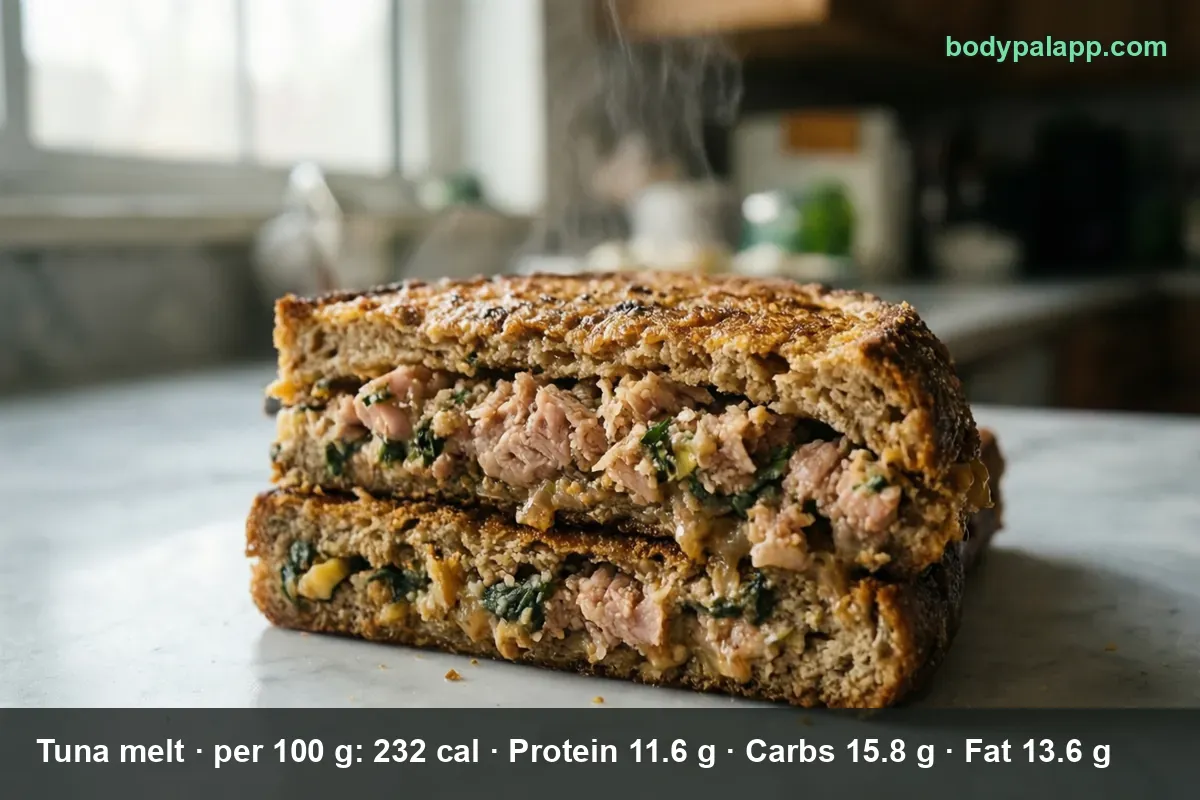
A tuna melt does not have its own line in the federal food tables. What it has is a line that describes it exactly: FNDDS 2707037, "Tuna salad sandwich on wheat, with cheese", from the 2021–2023 survey release. That is a tuna melt in every way that matters to the number — mayo-bound tuna, cheese, two slices of bread. The wheat version is the one used here because wholegrain bread is what most home melts get built on, and because it is the bread in the photo above.
The household measure attached to that record is one regular sandwich at 200 g, which is what the column below is scaled to. Values in the 100 g column are the record's own, unrounded.
| Nutrient | Per 100 g | Per 1 regular sandwich (200 g) | % Daily Value |
|---|---|---|---|
| Calories | 232 | 464 | — |
| Total fat | 13.62 g | 27.2 g | 35% |
| Saturated fat | 3.43 g | 6.9 g | 34% |
| Carbohydrate | 15.81 g | 31.6 g | 11% |
| Dietary fiber | 1.9 g | 3.8 g | 14% |
| Total sugars | 3.08 g | 6.2 g | — |
| Protein | 11.55 g | 23.1 g | 46% |
| Sodium | 486 mg | 972 mg | 42% |
% Daily Value is based on a 2,000-calorie diet.
Verified nutrition data
Numbers on this page come from USDA FoodData Central, the U.S. Department of Agriculture’s food composition database, and from manufacturer labels where a branded product is named. Last verified September 2026. How we verify our data →
Two rows you will see on a packaged label are missing here on purpose. USDA does not publish added sugars or trans fat for this survey record, so neither is estimated. Cholesterol comes in at 50 mg per sandwich, 17% of the Daily Value, and potassium at 330 mg, only 7% — a sandwich this size is not doing much for potassium.
US servings, from one ounce to a 6-inch sub
The tuna melt is one of the few sandwiches where the portion question is genuinely hard, because "one sandwich" covers a 200 g diner plate and a 300 g deli slab without changing its name. USDA lists both weights against the same record, which is why the calorie spread below is so wide for a single food.
| Serving | Weight | Calories |
|---|---|---|
| 1 oz (our arithmetic) | 28.4 g | 66 kcal |
| One mini melt or slider, or half a regular sandwich | 100 g | 232 kcal |
| One regular sandwich | 200 g | 464 kcal |
| One large sandwich or 6-inch submarine | 300 g | 696 kcal |
| Per 100 g | 100 g | 232 kcal |
The 200 g and 300 g rows are USDA household measures, as is the 100 g slider. The 1 oz row and the half-sandwich reading are our own arithmetic from the USDA 100 g figure, not USDA servings — handy if you cut a melt in two and give half away, or if you weigh what is left on the plate.
Weigh it once and you stop guessing forever. A melt cut from ordinary sandwich bread with a normal scoop of tuna salad lands near 200 g. A melt on thick-cut sourdough or a deli roll, with the tuna piled to the crusts, is a 300 g sandwich, and that is a 232-calorie difference for the same recipe.
Wheat, white, slider and sub
| Version | Per 100 g | Typical piece | Calories |
|---|---|---|---|
| Tuna melt on wheat bread | 232 kcal | one regular sandwich, 200 g | 464 kcal |
| Tuna melt on white bread | 233 kcal | one regular sandwich, 200 g | 466 kcal |
| 6-inch tuna melt submarine | 232 kcal | one sub, 300 g | 696 kcal |
| Mini tuna melt or slider | 232 kcal | one slider, 100 g | 232 kcal |
| Tuna salad wrap, no melt | 244 kcal | 100 g | 244 kcal |
| Fried fish sandwich with cheese | 247 kcal | 100 g | 247 kcal |
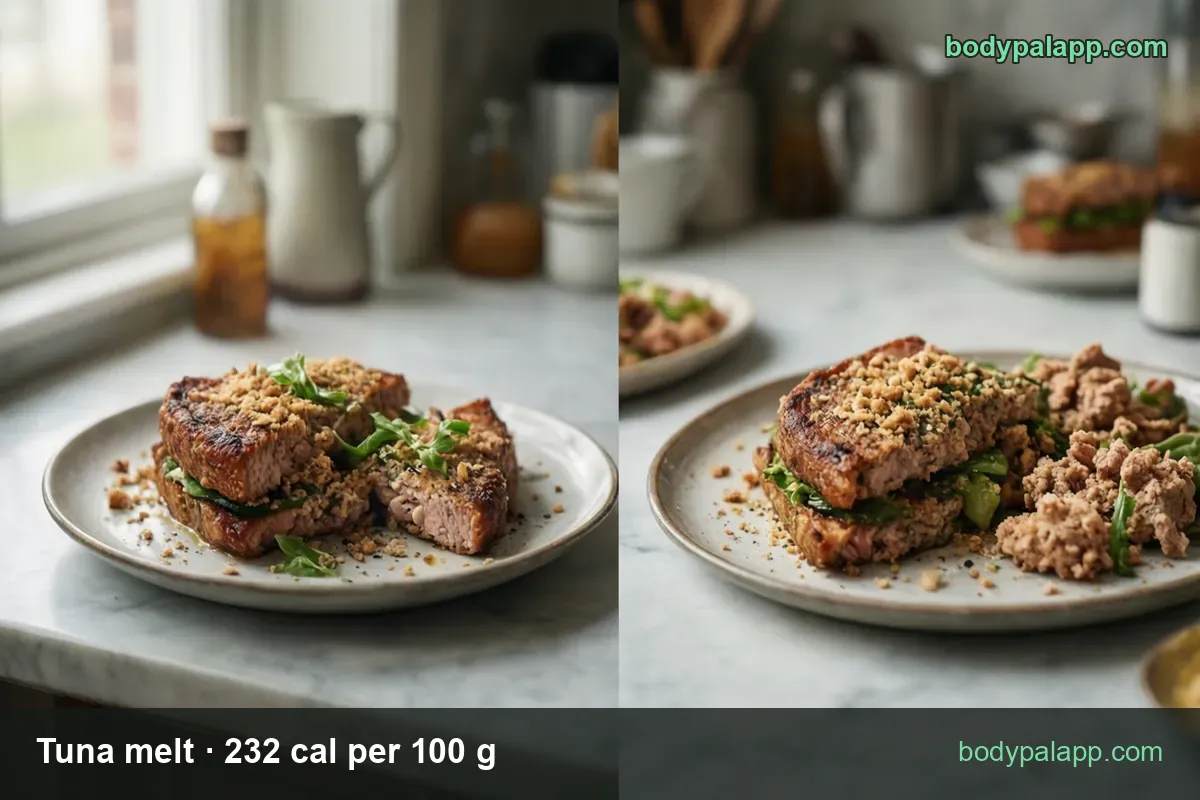
The bread swap is the surprise. Wheat and white come out at 232 and 233 calories per 100 g, a gap of two calories across a whole 200 g sandwich, which is noise. What the bread does move is fiber: the white-bread record has 0.9 g per 100 g against 1.9 g for wheat, so 1.8 g versus 3.8 g on the plate. If you are choosing bread for a calorie reason, there isn't one. If you are choosing it for fiber, wheat doubles the number.
The sub is where the damage happens. A 6-inch tuna melt submarine is 300 g of the same food, which is 696 calories — a 232-calorie jump over the diner-plate version with no change in filling, cheese or spread. It is a portion story, not a recipe story.
Two neighbors round out the family. A tuna salad wrap swaps toasted bread for a tortilla and drops the cheese, and still runs slightly denser at 244 calories per 100 g, because the tortilla is drier than bread. A fried fish sandwich on a wheat bun with cheese sits at 247. USDA does not publish gram weights for the wrap or the fried sandwich in this release, so no per-piece calorie figure is given for either — the density is all that can honestly be compared.
Sodium is the row to watch, not the fat
Most people brace for the fat in a tuna melt. The fat is real — 27.2 g per sandwich, 35% of the Daily Value, with 6.9 g of it saturated at 34% — but the row that outruns both is sodium. One 200 g melt brings 972 mg, 42% of the 2,300 mg Daily Value the FDA uses on labels. Scaled from the USDA 100 g figure, that is roughly two-fifths of a teaspoon of table salt in a single sandwich, before a pickle goes on the side.
Go up to the 6-inch sub and it is 1,458 mg, 63% of a day, from one item at lunch. Compare that with what you get back: the same sub delivers 34.7 g of protein, 69% of the Daily Value. Sodium and protein rise at almost the same rate, so the sandwich never becomes a better deal by getting bigger — it just gets bigger.
The protein itself is the honest selling point. At 23.1 g in the regular sandwich, a tuna melt clears the bar most sandwiches miss, and canned tuna is one of the seafood picks MyPlate lists in its protein foods group. The Dietary Guidelines put seafood twice a week on the table for adults, and a melt is one easy way to get there. If sodium is the number you are tracking, the half sandwich at 232 calories and 486 mg is the version that fits into a normal day.
How does a tuna melt compare?
| Sandwich | Per 100 g | US serving | Calories |
|---|---|---|---|
| Tuna melt on wheat, with cheese | 232 kcal | one regular sandwich, 200 g | 464 kcal |
| Tuna melt on white, with cheese | 233 kcal | one regular sandwich, 200 g | 466 kcal |
| Tuna salad wrap, no cheese | 244 kcal | one wrap, weight not published | — |
| Fried fish sandwich on a wheat bun, with cheese | 247 kcal | one regular sandwich, weight not published | — |
Our take: the tuna melt is the lightest per gram of these four, and only it and the white-bread build come with a published serving weight, so both are easy to log accurately. Dropping the cheese and going to a wrap does not save you anything per 100 g — 244 beats 232 in the wrong direction, because a tortilla packs more flour into less space than two slices of toast. If you want the melt to cost less, cut the sandwich, not the cheese. Half of one at 232 calories and 11.6 g of protein is a better lunch than a whole wrap you talked yourself into.
Tuna melt FAQs
How many calories are in a tuna melt?
A regular tuna melt of 200 g carries 464 calories, which is 232 calories per 100 g, using the USDA record for a tuna salad sandwich on wheat with cheese. The same sandwich brings 23.1 g of protein, 27.2 g of fat and 972 mg of sodium. A larger deli build at 300 g reaches 696.
How many calories in a tuna melt on wheat bread?
On wheat bread it is 464 calories for a 200 g sandwich, 232 per 100 g. Wheat against white barely moves calories, since white runs 233 per 100 g, two calories more across a whole sandwich. What changes is fiber: 3.8 g on wheat against 1.8 g on white.
How many calories in half a tuna melt?
Half a regular tuna melt is 100 g and 232 calories, which is our own arithmetic from the USDA 100 g figure rather than a USDA serving. That half also carries 11.6 g of protein, 6.8 g of fat and 486 mg of sodium, or 21% of the FDA Daily Value, in one small plate.
How much protein is in a tuna melt?
A 200 g tuna melt supplies 23.1 g of protein, 46% of the 50 g Daily Value, working out to 11.55 g per 100 g. A 300 g deli or submarine build reaches 34.7 g, or 69%. That puts a single sandwich close to half a day's protein from one lunch item.
How much sodium is in a tuna melt?
There are 972 mg of sodium in a 200 g tuna melt, 42% of the 2,300 mg Daily Value. The 6-inch submarine version at 300 g brings 1,458 mg, or 63%. Canned tuna, the cheese and the bread each carry salt, so the sandwich lands high before anything is added on the side.
How many calories in a 6-inch tuna melt sub?
A 6-inch tuna melt submarine weighs 300 g in the USDA household measures, which comes to 696 calories, 232 more than the 200 g sandwich. It also carries 34.7 g of protein, 40.9 g of fat and 1,458 mg of sodium, so it costs 63% of a day's sodium in one item.
Is a tuna melt healthy?
One 200 g tuna melt gives 23.1 g of protein and 3.8 g of fiber, 14% of the Daily Value, next to 972 mg of sodium and 6.9 g of saturated fat, which is 34% of the DV. If you are watching sodium, half a melt with a side salad is the better build.
Tuna melt vs tuna salad sandwich: which has more calories?
The melt is the USDA record itself, listed as a tuna salad sandwich on wheat with cheese at 232 calories per 100 g and 464 per 200 g sandwich. An untoasted, no-cheese build is not published separately in this FNDDS release, so the closest listed no-melt version is the tuna salad wrap at 244 per 100 g.
Similar foods
- Beef brisket — 208 cal per thick slice
- Chile relleno — 326 cal per chile relleno
- Chicken — 203 cal for 3 oz roasted
- Chuck Steak — 360 cal per steak
- Roast Chicken — 203 cal per 3 oz
- Tempura shrimp — 109 cal for 6 large shrimp
Count it without the math
Point the camera at the plate and BodyPal counts the melt for you, bread, tuna and cheese together.


How long does it take to burn off a tuna melt?
One regular sandwich (200 g) is 464 kcal. Enter your weight and the amount you ate to see how long it takes you to burn that off:
lb
| Activity | Time to burn 464 kcal |
|---|---|
| Walking, brisk | 1 hr 33 min |
| Cycling, moderate | 58 min |
| Swimming, moderate | 1 hr 6 min |
| Jogging | 55 min |
| Weight training, moderate | 1 hr 43 min |
Times are for a 155 lb adult at a steady pace; change the weight to see yours. The amount is set to the portion in the text (200 g); change it to what you actually ate. BodyPal works this out from your steps automatically.
One food is easy to picture; a whole day is harder. See how many calories you need a day and what a deficit actually looks like.