
How many calories are in a turkey and cheese sandwich?
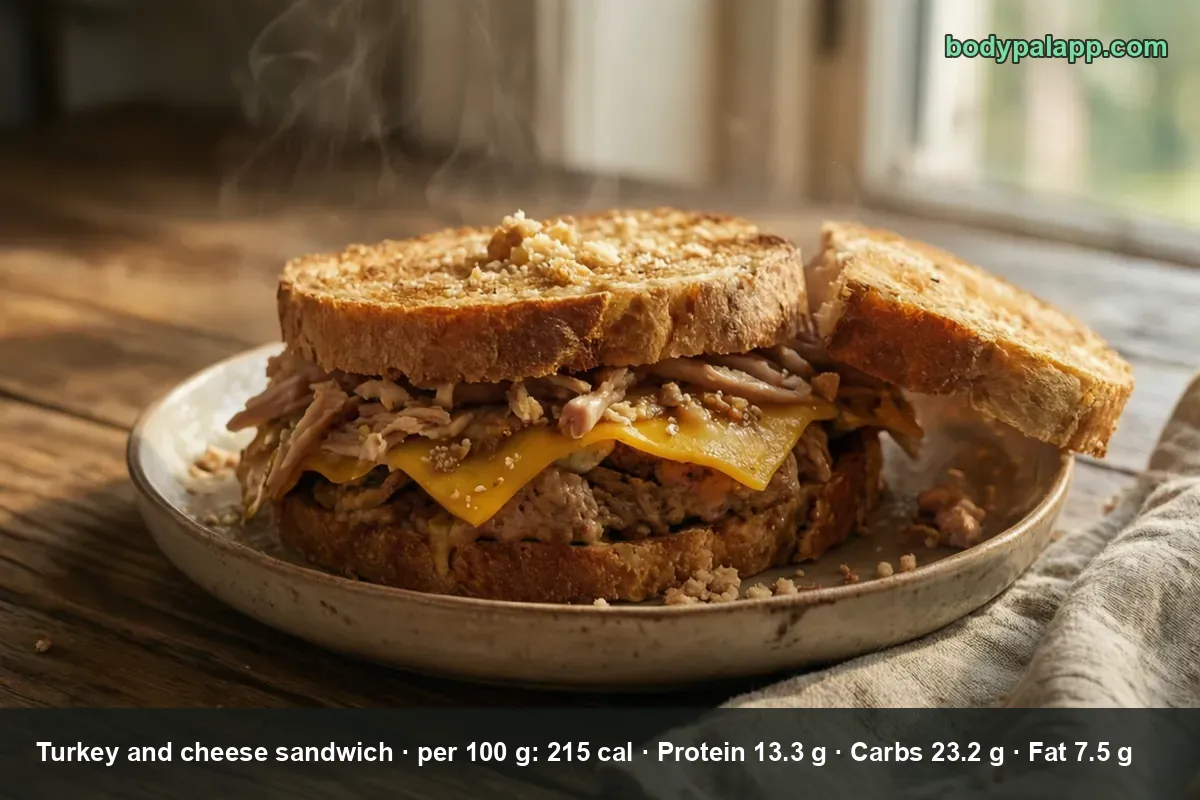
A regular turkey and cheese sandwich on white bread weighs 135 g and carries 290 calories. Per 100 g it runs 215 calories. That is bread, sliced turkey, cheese and a thin spread counted together, which is why the number lands higher than the turkey alone would suggest.
On this page
- Turkey and cheese sandwich quick facts
- US servings, from a slider to a 6-inch sub
- Wheat bread, deli subs and the ham version
- Sodium, not fat, is the row to watch
- How does a turkey and cheese sandwich compare?
- Most popular turkey and cheese sandwich brands
- FAQ
Turkey and cheese sandwich quick facts
The record behind this page is FNDDS 2706982, "Turkey sandwich on white, with cheese". It is the assembled sandwich most people actually hold at lunch: two slices of white bread, deli turkey, a slice of cheese and a thin spread. Six USDA records cover this sandwich family, and the other five are the same lunch on a different bread, from a restaurant counter, or with ham added to the turkey. Those sit in their own section below.
| Nutrient | Per 100 g | Per 1 regular sandwich (135 g) | % Daily Value |
|---|---|---|---|
| Calories | 215 | 290 | — |
| Total fat | 7.47 g | 10.1 g | 13% |
| Saturated fat | 3.23 g | 4.4 g | 22% |
| Carbohydrate | 23.22 g | 31.3 g | 11% |
| Dietary fiber | 1 g | 1.4 g | 5% |
| Total sugars | 3.14 g | 4.2 g | — |
| Protein | 13.31 g | 18.0 g | 36% |
| Sodium | 683 mg | 922 mg | 40% |
% Daily Value is based on a 2,000-calorie diet.
Verified nutrition data
Numbers on this page come from USDA FoodData Central, the U.S. Department of Agriculture’s food composition database, and from manufacturer labels where a branded product is named. Last verified September 2026. How we verify our data →
Two rows you will not find here. Added sugars and trans fat are absent from this FNDDS edition, so there is nothing honest to print for either. Cholesterol comes to 46 mg in the regular sandwich, 15% of the Daily Value, and potassium to 305 mg, about 6%. The FDA Daily Value reference sets the targets those percentages are measured against.
US servings, from a slider to a 6-inch sub
| Serving | Weight | Calories |
|---|---|---|
| 1 oz | 28 g | 61 kcal |
| One miniature sandwich or slider | 70 g | 151 kcal |
| One regular sandwich | 135 g | 290 kcal |
| One large sandwich or 6-inch sub | 205 g | 441 kcal |
| Per 100 g | 100 g | 215 kcal |
Everything except the ounce row is a USDA household measure for this record. The 1 oz line is our own arithmetic from the USDA 100 g figure, useful only when you are weighing leftovers.
The gap that trips people up is the one between regular and large. Same sandwich, same ingredients, 70 g more bread and filling, and 151 calories more. That is the whole slider. If you log "a turkey and cheese sandwich" out of habit and your bread is bakery-thick, you are probably closer to 441 than 290.
Half a regular sandwich comes to about 145 calories at 67.5 g, again our own arithmetic from the 215 per 100 g figure rather than a listed USDA serving. It is the easiest edit on this page: half the sandwich plus fruit lands under 250 calories for the plate.
Protein scales the same way. The regular sandwich holds 18.0 g, the large one 27.3 g, and a slider 9.3 g. Sodium scales too, and that is where it stops being friendly.
Wheat bread, deli subs and the ham version
| Version | Per 100 g | Typical serving | Calories |
|---|---|---|---|
| On white bread | 215 kcal | 1 regular, 135 g | 290 kcal |
| On wheat bread | 214 kcal | 1 regular, 135 g | 289 kcal |
| Deli sub with cheese, restaurant | 212 kcal | 1 regular, 160 g | 339 kcal |
| Turkey and ham on white | 195 kcal | 1 sandwich, 165 g | 322 kcal |
| Turkey and ham on wheat | 194 kcal | 1 sandwich, 165 g | 320 kcal |
| Turkey and ham sub, restaurant | 191 kcal | 1 regular, 195 g | 372 kcal |
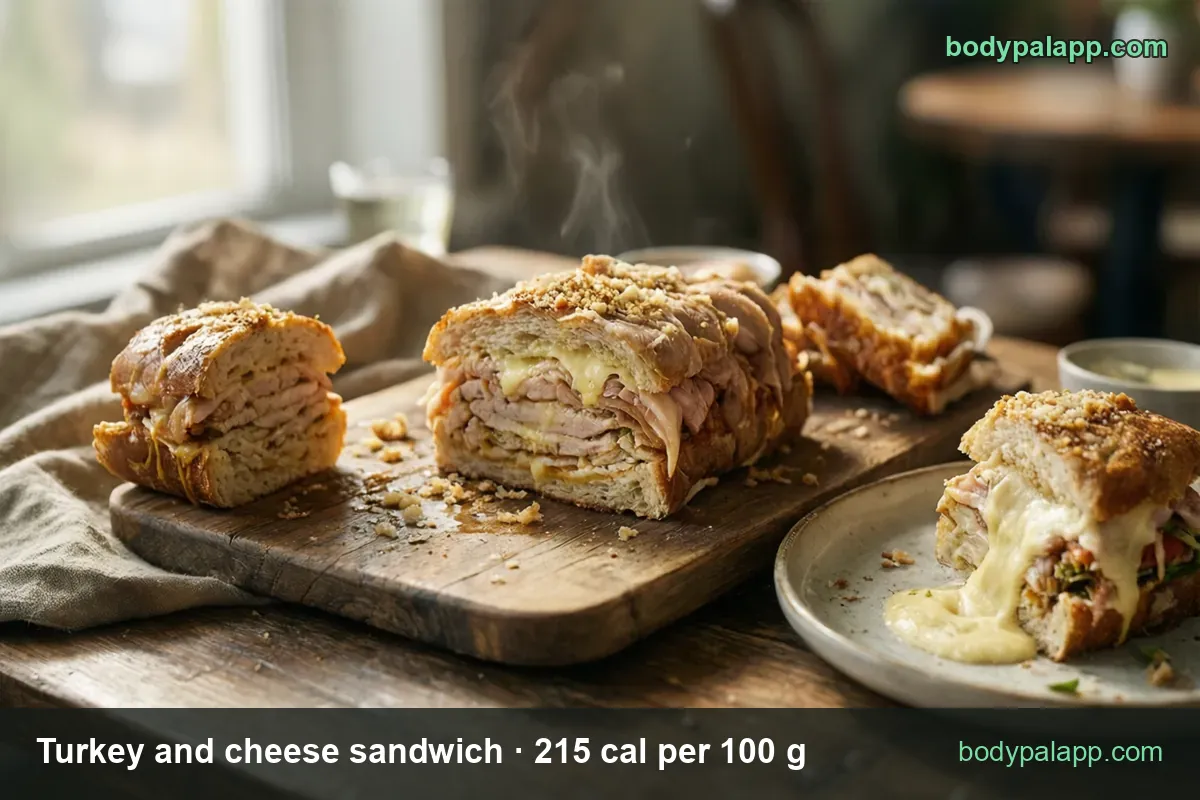
Wheat bread is not a calorie decision. FNDDS 2706984 puts the wheat version at 214 calories per 100 g against 215 for white, a difference of one calorie in a 135 g sandwich. What does move is fiber: 2.4 g per 100 g instead of 1 g, which turns a 1.4 g sandwich into a 3.2 g one, 12% of the Daily Value against 5%. Sodium barely budges, 917 mg instead of 922 mg. Swap the bread for the fiber and the protein bump to 19.1 g, and stop expecting it to save calories.
The restaurant version looks lighter and eats heavier. FNDDS 2706986 is 212 calories per 100 g, the lowest density of the three cheese-and-turkey builds. But a deli "regular" is 160 g, not 135 g, so it lands at 339 calories, and a 6-inch counter sub at 240 g works out to roughly 509 calories, our own arithmetic from the 100 g figure. Per gram it is the mildest of the three turkey-and-cheese builds. Per sandwich it is the biggest of them. Density is not portion.
Adding ham lowers the per-gram number and raises the plate. The three ham-and-turkey builds sit near 195 calories per 100 g, well under the turkey-only records, because the ham brings water along with the salt. The sandwiches are bigger, though — 165 g on bread and 195 g at the counter — so the white-bread version is 322 calories and the restaurant sub 372. Sodium is the tell: the ham-and-turkey sub carries about 1,461 mg, 64% of the Daily Value, in a single sandwich.
Store-made versions run wider still. USDA's branded records include a 128 g turkey and cheese bun sandwich at 280 calories and a croissant version at 310, while a 217 g chipotle turkey with pepper jack reaches 610. The bread and the spread do most of that work, not the turkey.
Sodium, not fat, is the row to watch
The saturated fat looks worse than it is. At 4.4 g, one regular sandwich is 22% of the Daily Value, which is real but manageable inside a day. Sodium is the row that quietly eats the budget: 922 mg is 40% of the 2,300 mg Daily Value, a little under half a teaspoon of table salt, in a lunch of 290 calories. The large sandwich pushes that to about 1,400 mg, 61%, and the restaurant sub versions run past 1,100 mg before you touch the chips.
That happens because two of the three main ingredients are cured. Deli turkey is brined, cheese is salted, and bread contributes on top. The Dietary Guidelines for Americans keep sodium among the nutrients most Americans overconsume, and a sandwich like this is exactly where it comes from.
The protein side of the ledger is genuinely good. Eighteen grams for 290 calories is a strong ratio for a cold lunch, and MyPlate counts sliced turkey as a lean protein food. If you are watching sodium, the lower-salt move is not the bread and not the mayo. It is one slice of cheese instead of two, and unsalted turkey breast sliced off a roast instead of the deli variety.
How does a turkey and cheese sandwich compare?
| Sandwich | Per 100 g | Same 135 g sandwich | Protein |
|---|---|---|---|
| Turkey and cheese on white | 215 kcal | 290 kcal | 18.0 g |
| Ham and cheese on white | 213 kcal | 288 kcal | 19.0 g |
| Roast beef and cheese on wheat | 217 kcal | 293 kcal | 21.2 g |
| Club sandwich on wheat | 220 kcal | 297 kcal | 21.6 g |
The 135 g column is our own arithmetic from each record's 100 g figure, so all four are compared at the same weight instead of at four different USDA servings.
Our take: at the same size these four sandwiches are effectively one sandwich, spread across nine calories. Ham and cheese is the lightest per 100 g at 213, turkey second at 215, and the club the heaviest at 220 despite the bacon and the third slice of bread. Protein is where they separate, and turkey comes last of the four at 18.0 g. So pick turkey for taste, not for the calorie math, and pick roast beef if you want the most protein per bite. What actually decides your lunch is the weight of the sandwich, not which cold cut is inside it.
Most popular turkey and cheese sandwich brands in the United States
Ranked by how widely each product appears among foods sold in the United States, from the BodyPal food database of over 3.3 million products. Calories are the figures printed on each Nutrition Facts label, checked against USDA FoodData Central.
| Product | Calories (per 100 g) |
|---|---|
| Bake Crafters Turkey Breast & Cheese Bun Sandwich | 219 cal |
| Bake Crafters Turkey Breast & Cheese Hoagie | 227 cal |
| Bake Crafters Turkey Breast & Cheese Croissant | 233 cal |
| Bake Crafters Cheese & Turkey Breast Bun Sandwich | 250 cal |
| Meijer Chipotle Turkey with Pepper Jack Sandwich | 281 cal |
| Taste of Inspirations California Style Turkey & Muenster | 177 cal |
Brand popularity: BodyPal food database. Nutrition: manufacturer labels / USDA FoodData Central.
Turkey and cheese sandwich FAQs
How many calories are in a turkey and cheese sandwich?
A regular turkey and cheese sandwich on white bread is 290 calories for 135 g, or 215 calories per 100 g. Build it large, at 205 g, and you are at 441. The USDA record counts bread, sliced turkey, cheese and a thin spread together, so a dry sandwich lands a little lower.
How much protein is in a turkey and cheese sandwich?
18.0 g of protein in the regular 135 g sandwich, which is 36% of the Daily Value. The large 205 g version carries 27.3 g and a 70 g slider 9.3 g. Protein is the row where this lunch beats most things of the same weight, and it is why 290 calories hold until dinner.
How many calories in a 6 inch turkey and cheese sub?
441 calories for a 6-inch sub built like the USDA white-bread record, which weighs 205 g. A deli-counter sub is bigger and richer. At 240 g and 212 calories per 100 g that comes to about 509 calories, our own arithmetic from the USDA 100 g figure rather than a listed serving.
Does wheat bread lower the calories in a turkey sandwich?
No, wheat is 214 calories per 100 g against 215 for white, so the same 135 g sandwich is 289 instead of 290. What changes is fiber: 3.2 g instead of 1.4 g, which is 12% of the Daily Value against 5%. Swap the bread for the fiber, not for the calorie count.
How much sodium is in a turkey and cheese sandwich?
922 mg in the regular 135 g sandwich, 40% of the 2,300 mg Daily Value and a little under half a teaspoon of table salt. The large 205 g sandwich reaches about 1,400 mg, or 61%. Deli turkey and cheese are both cured or salted, so the bread is rarely the problem.
Is a turkey and cheese sandwich healthy?
At 290 calories with 18.0 g of protein and 1.4 g of fiber, it is a solid lunch by most measures. The weak spots are 922 mg of sodium, 40% of a day, and 4.4 g of saturated fat, 22%. Wheat bread more than doubles the fiber, and one slice of cheese moves the fat.
How many calories in half a turkey and cheese sandwich?
145 calories for half a regular sandwich, which is 67.5 g. That is our own arithmetic from the USDA figure of 215 per 100 g, not a listed USDA serving. Half of the large 205 g sandwich is about 221 calories, and a 70 g slider sits between the two at 151.
Is turkey and cheese good for weight loss?
290 calories for 18.0 g of protein is a strong ratio for lunch, and MyPlate counts sliced turkey as a lean protein food. The catch is what surrounds it. A bag of chips and a soda can double the meal, while half a sandwich plus fruit keeps the plate under 250 calories.
Similar foods
- Mac And Cheese — 513 cal per cup
- Prosciutto — 55 cal for 3 thin slices
- Baba ganoush — 110 cal for 1/4 cup
- Maple Syrup — 216 cal for 1/4 cup
- Penne pasta — 169 cal per cup
- Pasta — 168 cal per cup penne
Count it without the math
Point the camera at the plate and BodyPal counts the sandwich for you, bread, turkey, cheese and all.


How long does it take to burn off 290 kcal of turkey and cheese sandwich?
One regular sandwich (135 g) is 290 kcal. Enter your weight and the amount you ate to see how long it takes you to burn that off:
lb
| Activity | Time to burn 290 kcal |
|---|---|
| Walking, brisk | 58 min |
| Cycling, moderate | 36 min |
| Swimming, moderate | 41 min |
| Jogging | 34 min |
| Weight training, moderate | 1 hr 4 min |
Times are for a 155 lb adult at a steady pace; change the weight to see yours. The amount is set to the portion in the text (135 g); change it to what you actually ate. BodyPal works this out from your steps automatically.
One food is easy to picture; a whole day is harder. See how many calories you need a day and what a deficit actually looks like.