
How many calories are in turkey soup?
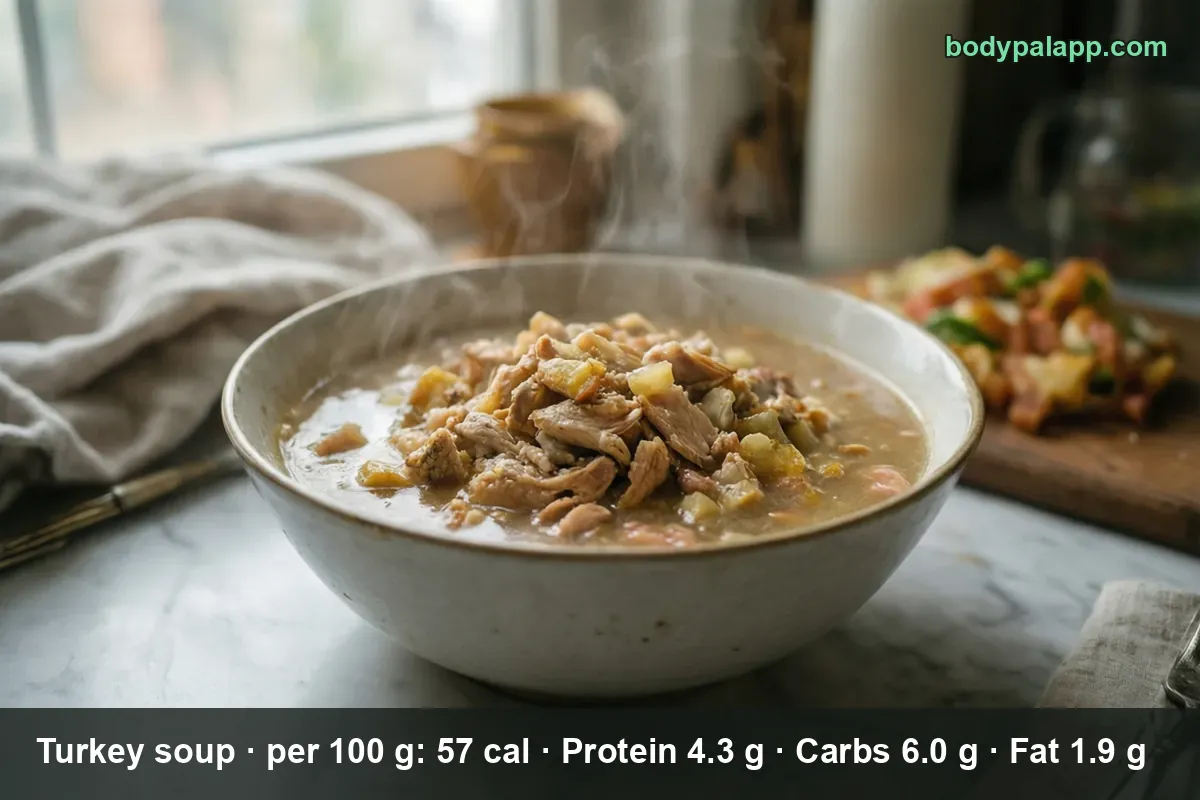
A 1-cup serving of chunky turkey soup, 236 g of it, carries 135 calories. Per 100 g the soup runs 57 calories, which puts it among the lightest things you can eat by the bowlful. The whole 18.75 oz can is 303. Protein does well here; sodium does not.
On this page
- Turkey soup quick facts
- US servings, from half a cup to the whole can
- Noodle, vegetable and creamy turkey soups
- Sodium is the row that matters
- How does turkey soup compare?
- Most popular turkey soup brands
- Turkey soup FAQs
Turkey soup quick facts
The record behind every number on this page is SR Legacy 171558, "Soup, turkey, chunky, canned, ready-to-serve". It was chosen because it matches what people actually have in the bowl: thick broth with visible pieces of turkey and vegetables, eaten straight from the container with nothing added. The condensed cans are a different animal. Those are sold as a concentrate and get diluted one-to-one with water, which cuts the calories per spoonful roughly in half before anyone tastes it.
That distinction matters more than the brand on the label. If you scoop from a ready-to-serve can, use the numbers below. If you added a can of water, jump to the variants section.
| Nutrient | Per 100 g | Per 1 cup (236 g) | % Daily Value |
|---|---|---|---|
| Calories | 57 | 135 | — |
| Total fat | 1.87 g | 4.4 g | 6% |
| Saturated fat | 0.52 g | 1.2 g | 6% |
| Carbohydrate | 5.96 g | 14.1 g | 5% |
| Protein | 4.33 g | 10.2 g | 20% |
| Sodium | 391 mg | 923 mg | 40% |
| Cholesterol | 4 mg | 9 mg | 3% |
| Potassium | 153 mg | 361 mg | 8% |
% Daily Value is based on a 2,000-calorie diet.
Verified nutrition data
Numbers on this page come from USDA FoodData Central, the U.S. Department of Agriculture’s food composition database, and from manufacturer labels where a branded product is named. Last verified September 2026. How we verify our data →
There is no dietary fiber, total sugars, added sugars or trans fat row here because USDA does not publish those values for this canned soup record. Rather than borrow figures from a different product, they are left out. Everything else on the label is covered: the cup delivers 9 mg of cholesterol and 361 mg of potassium, both small enough to ignore unless you are tracking them closely.
The one line worth staring at is protein. Ten grams in a 135-calorie cup is a ratio most soups cannot touch, and it comes from the meat rather than from added starch. The MyPlate protein foods guidance treats poultry as one of the leanest ways to hit a daily protein target, and a cup of this soup does about a fifth of it.
US servings, from half a cup to the whole can
| Serving | Weight | Calories |
|---|---|---|
| 1 oz | 28.4 g | 16 kcal |
| 1/2 cup | 118 g | 67 kcal |
| 1 cup (8 fl oz) | 236 g | 135 kcal |
| 2 cups | 472 g | 269 kcal |
| 1 can (18.75 oz) | 532 g | 303 kcal |
| Per 100 g | 100 g | 57 kcal |
Two of these come straight from USDA as household measures: the 236 g cup and the 532 g can. The half cup, the two-cup bowl and the ounce are our own arithmetic from the USDA 100 g figure, not USDA servings, so treat them as clean scaling rather than measured portions.
The practical point is that the can and the cup are not the same unit, and people log them as though they were. An 18.75 oz can is 2.25 cups, not two. Eating the whole thing is 303 calories, which is a genuinely light dinner, and that is why turkey soup shows up so often in weight-loss meal rotations. A cup as a starter before something else is 135, roughly what a slice of bread and a smear of butter would cost you.
Two supermarket labels show how far a can can drift from the generic record. Nob Hill Trading Co. Creamy Harvest Turkey Soup is 106 calories per 100 g, or 260 for its 245 g cup, because cream doubles the density. Lunds & Byerlys White Bean with Turkey Soup sits at 78 per 100 g, 221 for the 283 g bowl on its label, with the beans doing the work. Neither is a brothy soup in the sense the USDA record describes.
Noodle, vegetable and creamy turkey soups
| Version | Per 100 g | Typical serving | Calories |
|---|---|---|---|
| Chunky turkey soup, ready-to-serve | 57 kcal | 1 cup (236 g) | 135 kcal |
| Turkey noodle soup, prepared with water | 28 kcal | 1 cup (244 g) | 68 kcal |
| Turkey vegetable soup, prepared with water | 30 kcal | 1 cup (241 g) | 72 kcal |
| Whole can turkey noodle soup, prepared | 28 kcal | 1 can 10.75 oz (593 g) | 166 kcal |
| Creamy turkey a la king with vegetables | 187 kcal | 1 cup (241 g) | 451 kcal |
| Turkey a la king, no carrots or dark greens | 181 kcal | 1 cup (241 g) | 436 kcal |
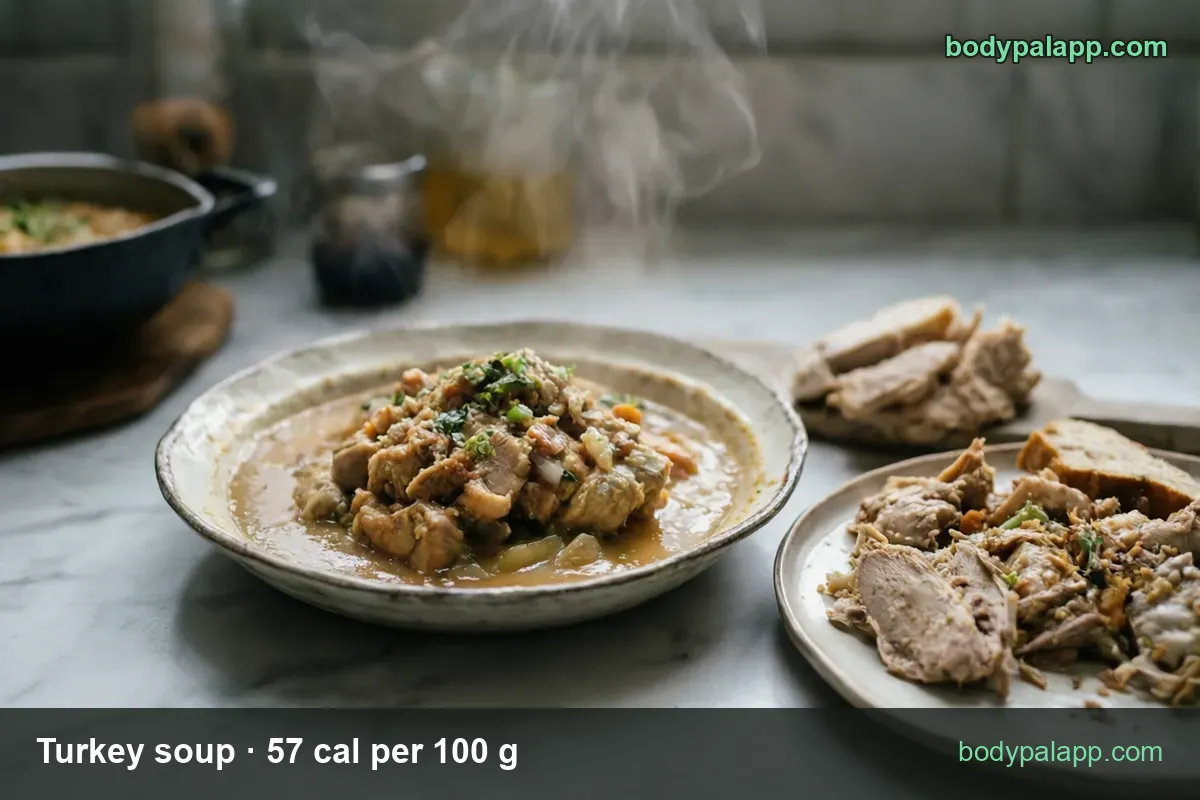
Only two of the five USDA turkey soup records are lighter than the chunky one, and both get there the same way: water. Turkey noodle and turkey vegetable are condensed soups measured after being diluted with an equal volume of water, so half of what is in the bowl is literally water. A whole 10.75 oz can of prepared turkey noodle, which fills two and a half cups, is 166 calories. That is a little over half of what the ready-to-serve can costs, and it carries less than half the meat: 1.6 g of protein per 100 g against 4.33 g.
Turkey noodle and turkey vegetable are four calories apart per cup. Choosing between them on calories alone is a waste of attention. The noodle version has slightly more protein, the vegetable version slightly more fat, and both are so dilute that a cracker on the side changes the total more than the choice does.
Then there is the version that looks like soup and is not. Creamy turkey a la king with vegetables is 187 calories per 100 g, so a 241 g cup lands at 451 calories, more than three times the chunky broth soup at the same volume. Fat explains all of it: 13.8 g per 100 g against 1.87 g. If your bowl is opaque, pale and coats the spoon, you are eating a la king, not soup, and the gap is about 316 calories a cup.
Sodium is the row that matters
A cup of canned chunky turkey soup has 923 mg of sodium, which is 40% of the 2,300 mg Daily Value used on US labels. Put another way, that cup is close to a little under half a teaspoon of table salt dissolved into it. The full 18.75 oz can reaches 2,080 mg, or 90% of a day's worth, for only 303 calories. That inversion is the whole story of canned soup: the calories stay tiny while the sodium does not.
Condensed soups do not fix it. Prepared with water, turkey noodle still runs 334 mg per 100 g and turkey vegetable 376 mg, barely below the 391 mg of the ready-to-serve version, because the salt is dosed to taste after dilution. Diluting the calories does not dilute the seasoning.
If sodium is something you track, the workable moves are ordinary ones: split the can across two meals, skip the crackers, and check whether a low-sodium version of the same product exists on the shelf. The FDA's Daily Value reference is what the percentages on any can are measured against, and the Dietary Guidelines for Americans treat 2,300 mg as the ceiling rather than the target. One can of soup is most of it.
How does turkey soup compare?
| Soup | Per 100 g | US serving | Calories |
|---|---|---|---|
| Turkey soup, chunky, ready-to-serve | 57 kcal | 1 cup, 236 g | 135 kcal |
| Turkey noodle, prepared with water | 28 kcal | 1 cup, 244 g | 68 kcal |
| Turkey vegetable, prepared with water | 30 kcal | 1 cup, 241 g | 72 kcal |
| Turkey a la king with vegetables | 187 kcal | 1 cup, 241 g | 451 kcal |
Our take: for a lunch you want to feel, the chunky ready-to-serve soup wins. It costs 67 more calories than turkey noodle but carries 10.2 g of protein instead of about 3.9 g by our own arithmetic, and protein is what keeps a 135-calorie bowl from turning into a snack raid an hour later. If you are eating soup as a starter and the main course is the real meal, the condensed versions at 68 to 72 a cup are the cheaper way to fill the gap. The a la king is not in the same conversation. At 451 a cup it is a dinner, and it should be logged as one.
Most popular turkey soup brands in the United States
Ranked by how widely each product appears among foods sold in the United States, from the BodyPal food database of over 3.3 million products. Calories are the figures printed on each Nutrition Facts label, checked against USDA FoodData Central.
| Product | Calories (per 100 g) |
|---|---|
| Nob Hill Trading Co. Creamy Harvest Turkey Soup | 106 cal |
| Lunds & Byerlys White Bean with Turkey Soup | 78 cal |
Brand popularity: BodyPal food database. Nutrition: manufacturer labels / USDA FoodData Central.
Turkey soup FAQs
How many calories are in a cup of turkey soup?
A 1-cup serving of chunky ready-to-serve turkey soup weighs 236 g and holds 135 calories. That comes from 57 calories per 100 g, one of the lower figures in the canned soup aisle. The same cup carries 10.2 g of protein and 923 mg of sodium.
How many calories in a whole can of turkey soup?
The 18.75 oz can holds 532 g and 303 calories, which is a light dinner by any measure. The catch is sodium: 2,080 mg, or 90% of a day's Daily Value, in one container. Splitting the can over two meals halves both numbers.
How much sodium is in canned turkey soup?
One cup of canned chunky turkey soup carries 923 mg of sodium, 40% of the 2,300 mg Daily Value, and roughly what you would get from a little under half a teaspoon of table salt. Per 100 g it is 391 mg. The condensed soups prepared with water land at 334 to 376 mg per 100 g.
How much protein is in turkey soup?
A cup of chunky turkey soup gives 10.2 g of protein, 20% of the Daily Value, from 4.33 g per 100 g. That is real protein for 135 calories, better than most vegetable soups. The condensed turkey noodle version drops to 1.6 g per 100 g, about 3.9 g in a cup by our own arithmetic.
Is turkey noodle soup lower in calories than turkey vegetable soup?
Barely: turkey noodle prepared with water is 28 calories per 100 g and 68 in a 244 g cup; turkey vegetable is 30 per 100 g and 72 in a 241 g cup. Four calories apart is noise. Sodium separates them more clearly: 334 mg against 376 mg per 100 g.
Is turkey soup good for weight loss?
At 135 calories and 10.2 g of protein a cup, chunky turkey soup is one of the easier lunches to fit inside a 350 to 450 calorie meal. Two cups come to 269 calories by our own arithmetic. If you are watching sodium, the 923 mg per cup is the trade-off.
Does creamy turkey soup have more calories?
Much more: creamy turkey a la king with vegetables runs 187 calories per 100 g and 451 in a 241 g cup, more than three times the 135 of chunky broth soup. Fat drives it: 13.8 g per 100 g against 1.87 g. A cream base changes the dish, not the meat.
How many calories in homemade turkey soup?
USDA publishes no record for homemade turkey soup, so the closest stand-in is the chunky canned version at 57 calories per 100 g, 135 a cup. A pot made from leftover roast turkey, broth and vegetables usually lands lower in sodium, since the 391 mg per 100 g comes mostly from the can.
Similar foods
- Ceviche — 158 cal per cup
- Clementine — 35 cal per clementine
- Tom yum soup — 191 cal per bowl
- Pomegranate — 72 cal for 1/2 cup arils
- Clam Chowder — 237 cal per cup
- Chinese Chicken and Broccoli — 206 cal per cup
Count it without the math
Point the camera at the bowl and BodyPal counts the turkey soup for you, broth, meat and all.


How long does it take to burn off turkey soup?
A 1-cup (236 g) serving is 135 kcal. Enter your weight and the amount you ate to see how long it takes you to burn that off:
lb
| Activity | Time to burn 135 kcal |
|---|---|
| Walking, brisk | 27 min |
| Cycling, moderate | 17 min |
| Swimming, moderate | 19 min |
| Jogging | 16 min |
| Weight training, moderate | 30 min |
Times are for a 155 lb adult at a steady pace; change the weight to see yours. The amount is set to the portion in the text (236 g); change it to what you actually ate. BodyPal works this out from your steps automatically.
One food is easy to picture; a whole day is harder. See how many calories you need a day and what a deficit actually looks like.