
How many calories are in vegetable beef soup?
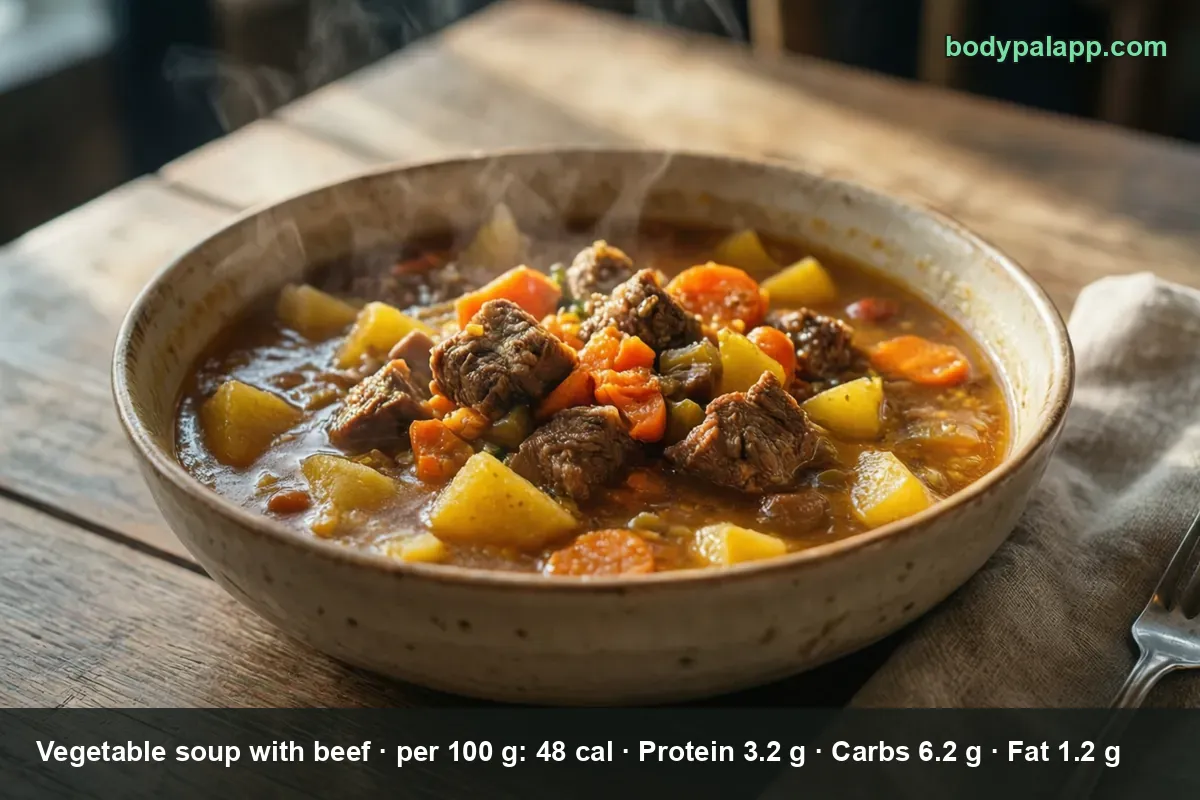
A 1-cup (250 g) serving of canned, ready-to-serve vegetable beef soup is 120 calories. Per 100 g the soup runs 48 calories, about as light as a hot meal made of real food gets. The beef, broth and vegetables together bring 8.0 g of protein and 3.0 g of fiber to that cup.
On this page
- Vegetable beef soup quick facts
- US servings from one ounce to the whole can
- Condensed chunky and reduced sodium versions
- Sodium is the row to watch
- How does vegetable beef soup compare
- Most popular vegetable soup with beef brands
- Vegetable beef soup FAQs
Vegetable beef soup quick facts
The numbers below come from the USDA record Soup, beef and vegetables, canned, ready-to-serve (fdc_id 171190). That record was picked because it describes what a person actually holds: soup poured straight from the can into a bowl, no water added, no measuring involved. USDA also publishes condensed records, but a condensed can is food in a container before it becomes food in a bowl.
| Nutrient | Per 100 g | Per 1 cup (250 g) | % Daily Value |
|---|---|---|---|
| Calories | 48 | 120 | — |
| Total fat | 1.16 g | 2.9 g | 4% |
| Saturated fat | 0.41 g | 1.0 g | 5% |
| Carbohydrate | 6.16 g | 15.4 g | 6% |
| Dietary fiber | 1.2 g | 3.0 g | 11% |
| Total sugars | 1.25 g | 3.1 g | — |
| Protein | 3.18 g | 8.0 g | 16% |
| Sodium | 326 mg | 815 mg | 35% |
% Daily Value is based on a 2,000-calorie diet.
Verified nutrition data
Numbers on this page come from USDA FoodData Central, the U.S. Department of Agriculture’s food composition database, and from manufacturer labels where a branded product is named. Last verified September 2026. How we verify our data →
Two rows you would see on a supermarket label are missing here: added sugars and trans fat. The SR Legacy edition of this record does not publish either value, so leaving them out is more honest than guessing. Cholesterol and potassium are published: a cup carries 18 mg of cholesterol (6% of the Daily Value) and 435 mg of potassium (9%), the potassium coming mostly from the potatoes and carrots.
US servings from one ounce to the whole can
| Serving | Weight | Calories |
|---|---|---|
| 1 oz | 28 g | 13 kcal |
| Half a cup | 125 g | 60 kcal |
| 1 cup | 250 g | 120 kcal |
| Deep bowl, 1 1/2 cups | 375 g | 180 kcal |
| One whole can | 528 g | 253 kcal |
| Per 100 g | 100 g | 48 kcal |
The 1-cup and one-can figures are USDA household measures for this record. The half cup, the ounce and the deep 1 1/2-cup bowl are our own arithmetic from the USDA 100 g figure, not USDA servings, which is why they land on round multiples.
Here is the trap. Most people do not eat a level cup of soup. A wide restaurant-style bowl holds closer to a cup and a half, which is 180 calories, and pouring the whole can into one bowl at lunch is 253. That is still a modest lunch by calories, but the sodium climbs at the same rate, and the sodium is what actually gets you.
Condensed chunky and reduced sodium versions
| Version | Per 100 g | Typical serving | Calories | Sodium |
|---|---|---|---|---|
| Canned, ready to serve | 48 kcal | 1 cup (250 g) | 120 kcal | 815 mg |
| Condensed, as canned | 63 kcal | 1/2 cup (126 g) | 79 kcal | 890 mg |
| Condensed, prepared with water | 31 kcal | 1 cup (244 g) | 76 kcal | 852 mg |
| Chunky old fashioned | 49 kcal | 1 cup (247 g) | 121 kcal | 855 mg |
| Vegetable with beef broth, condensed | 66 kcal | 1/2 cup (123 g) | 81 kcal | 633 mg |
| Microwavable single-serve bowl | 44 kcal | 1 bowl (292 g) | 128 kcal | 1098 mg |
| Reduced sodium, ready to serve | 42 kcal | 1 cup (245 g) | 103 kcal | 429 mg |
Condensed versus prepared is the single biggest source of logging errors on this food. As canned, condensed vegetable beef soup is 63 calories per 100 g. Stir in an equal volume of water and the same soup is 31 calories per 100 g. Nothing was removed; water was added, and the number per gram fell by half. Log the bowl in front of you, not the can it came from. The sodium figures in this table are our own arithmetic from the USDA 100 g values.
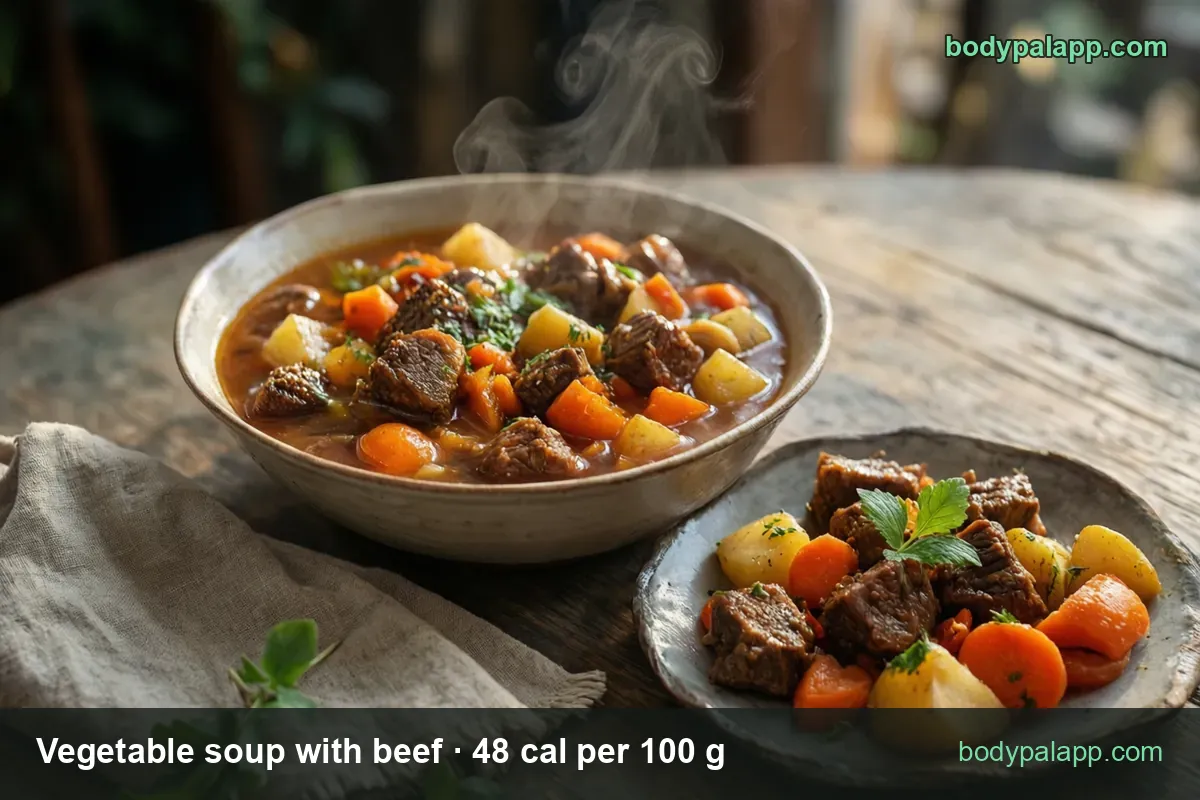
Chunky style barely moves the calories. The USDA record for chunky old fashioned vegetable beef soup is 49 calories per 100 g against 48 for the standard canned version, so a 247 g cup is 121 calories instead of 120. Bigger beef and vegetable pieces change how full the bowl feels, not what it costs you.
Beef broth is not beef. Soup made with vegetables and beef broth reads 66 calories per 100 g, higher than the beef-and-vegetables record, yet a half cup carries only about 3.0 g of protein because the meat is mostly a flavor, not an ingredient. If you are eating soup for the protein, read the name carefully.
The microwavable bowl is the protein outlier: 6.2 g per 100 g, nearly double the canned record, so one 292 g bowl delivers about 18.1 g of protein for 128 calories. It also carries the most sodium of any version here.
Reduced sodium cans exist and they work. At 42 calories per 100 g and 175 mg of sodium per 100 g, a 245 g cup is 103 calories and roughly 429 mg of sodium, against 815 mg for the regular can. The 245 g cup weight and its totals are our own arithmetic from the USDA 100 g figures.
Store brands land inside this same band. Campbell's Chunky reads 120 calories per 1-cup serving on the label and Campbell's Homestyle 110, while the condensed can is labeled 80 calories per half cup as sold. Heartier private-label versions such as B. Robert's Beef & Vegetable run higher at 66 calories per 100 g.
Sodium is the row to watch
One cup of ready-to-serve vegetable beef soup carries 815 mg of sodium. Against the FDA Daily Value of 2,300 mg that is 35% of a day, or about a third of a teaspoon of table salt, from a 120-calorie bowl. Calorie for calorie, few things in a normal pantry are that salty.
Scale it up and the picture sharpens. A whole 528 g can is about 1,721 mg, roughly 75% of the Daily Value, our own arithmetic from the USDA 100 g figure. A condensed 305 g can, before any water goes in, holds about 2,153 mg, or 94% of a day in one container. The CDC notes that most sodium in the American diet comes from packaged and restaurant foods rather than the salt shaker, and canned soup is one of the clearest examples.
The counterweight is real, though. For 120 calories, a cup gives 8.0 g of protein (16% of the Daily Value) and 3.0 g of fiber (11%), which is a better nutrient-per-calorie trade than most convenience lunches. The Dietary Guidelines for Americans treat vegetables and lean protein as the two things most people short themselves on, and this bowl delivers both. If you are watching sodium, buy the reduced-sodium can and keep everything else; you give up 17 calories per cup and cut the salt roughly in half.
How does vegetable beef soup compare
| Soup | Per 100 g | US serving | Calories |
|---|---|---|---|
| Vegetable beef, ready to serve | 48 kcal | 1 cup (250 g) | 120 kcal |
| Beef mushroom, condensed | 61 kcal | 1/2 cup (126 g) | 77 kcal |
| Chicken vegetable, condensed | 61 kcal | 1/2 cup (121 g) | 74 kcal |
| Bean with pork, prepared with water | 63 kcal | 1 cup (266 g) | 168 kcal |
Our take: vegetable beef is the lightest of these four per 100 g, and it is not close. Two of its rivals are condensed records, which is why their half-cup servings look small on paper, and bean with pork is the only other one measured as a full prepared cup, at 168 calories against 120. If you want the fullest bowl for the fewest calories, vegetable beef wins. If you want the most protein per bowl, the microwavable single-serve version of this same soup beats all of them at about 18.1 g. Bean with pork is the pick only when you want a thicker, more filling lunch and have the calories to spend.
Most popular vegetable soup with beef brands in the United States
Ranked by how widely each product appears among foods sold in the United States, from the BodyPal food database of over 3.3 million products. Calories are the figures printed on each Nutrition Facts label, checked against USDA FoodData Central.
| Product | Calories (per 100 g) |
|---|---|
| Campbell's Chunky Vegetable Beef Soup | 50 cal |
| Campbell's Homestyle Vegetable Beef Soup | 46 cal |
| Campbell's Condensed Vegetable Beef Soup (as sold) | 67 cal |
| Food Club Beef Barley with Homestyle Vegetables | 49 cal |
| B. Robert's Beef & Vegetable Soup | 66 cal |
| Smart & Final Beef & Vegetable Hearty Soup | 62 cal |
Brand popularity: BodyPal food database. Nutrition: manufacturer labels / USDA FoodData Central.
Vegetable beef soup FAQs
How many calories are in a bowl of vegetable beef soup?
A deep 1 1/2-cup bowl (375 g) of canned ready-to-serve vegetable beef soup is 180 calories, scaled from the USDA figure of 48 calories per 100 g. A standard 1-cup bowl is 120. That deeper bowl also carries 11.9 g of protein and about 1,223 mg of sodium.
How many calories in 1 cup of vegetable beef soup?
One cup (250 g) is 120 calories. It brings 8.0 g of protein, 15.4 g of carbohydrate, 3.0 g of fiber and only 2.9 g of fat. Per gram it is one of the lightest canned soups on the shelf, though the sodium tells a different story at 815 mg.
How much protein is in vegetable beef soup?
A 1-cup serving has 8.0 g of protein, 16% of the Daily Value. The microwavable single-serve bowl is the outlier at 6.2 g per 100 g, so a 292 g bowl delivers about 18.1 g. Soup made with beef broth instead of beef meat gives roughly 3.0 g per half cup.
How much sodium is in canned vegetable beef soup?
One cup holds 815 mg of sodium, 35% of the 2,300 mg Daily Value, or about a third of a teaspoon of table salt. The reduced-sodium USDA record runs 175 mg per 100 g instead of 326, which brings a 245 g cup down to roughly 429 mg.
Condensed or ready to serve, which calorie number do I log?
Log the one in your bowl: condensed soup as canned is 63 calories per 100 g; the same soup after you stir in an equal volume of water is 31. A half cup of concentrate is 79 calories, and the full prepared cup lands at 76 calories.
How many calories in Campbell's Chunky Vegetable Beef Soup?
The label reads 120 calories for a 1-cup (240 mL) serving, at 50 calories per 100 g. The USDA record for chunky old fashioned vegetable beef soup is close at 49 calories per 100 g, so a 247 g cup works out to 121. The chunks change texture, not math.
Is vegetable beef soup good for weight loss?
At 48 calories per 100 g it is one of the lower-calorie hot meals you can log, and a cup at 120 calories brings 8.0 g of protein and 3.0 g of fiber. Two full cups still land under 250 calories. If you are watching sodium, choose the reduced-sodium can.
How many calories in a whole can of vegetable beef soup?
A 528 g can is 253 calories, our own arithmetic from the USDA figure of 48 per 100 g. Eaten in one sitting it also delivers 16.8 g of protein and about 1,721 mg of sodium, 75% of the Daily Value. Splitting the can halves both numbers.
Similar foods
- Clementine — 35 cal per clementine
- Tom yum soup — 191 cal per bowl
- Ceviche — 158 cal per cup
- Pomegranate — 72 cal for 1/2 cup arils
- Clam Chowder — 237 cal per cup
- Chinese Chicken and Broccoli — 206 cal per cup
Count it without the math
Point the camera at the bowl and BodyPal counts the soup for you, beef and broth included.


How long does it take to burn off 120 kcal of vegetable beef soup?
A 1-cup (250 g) serving is 120 kcal. Enter your weight and the amount you ate to see how long it takes you to burn that off:
lb
| Activity | Time to burn 120 kcal |
|---|---|
| Walking, brisk | 24 min |
| Cycling, moderate | 15 min |
| Swimming, moderate | 17 min |
| Jogging | 14 min |
| Weight training, moderate | 27 min |
Times are for a 155 lb adult at a steady pace; change the weight to see yours. The amount is set to the portion in the text (250 g); change it to what you actually ate. BodyPal works this out from your steps automatically.
This table assumes you know your daily total. If you do not, the daily calorie calculator works it out from five numbers.