
How many calories are in vegetable soup?
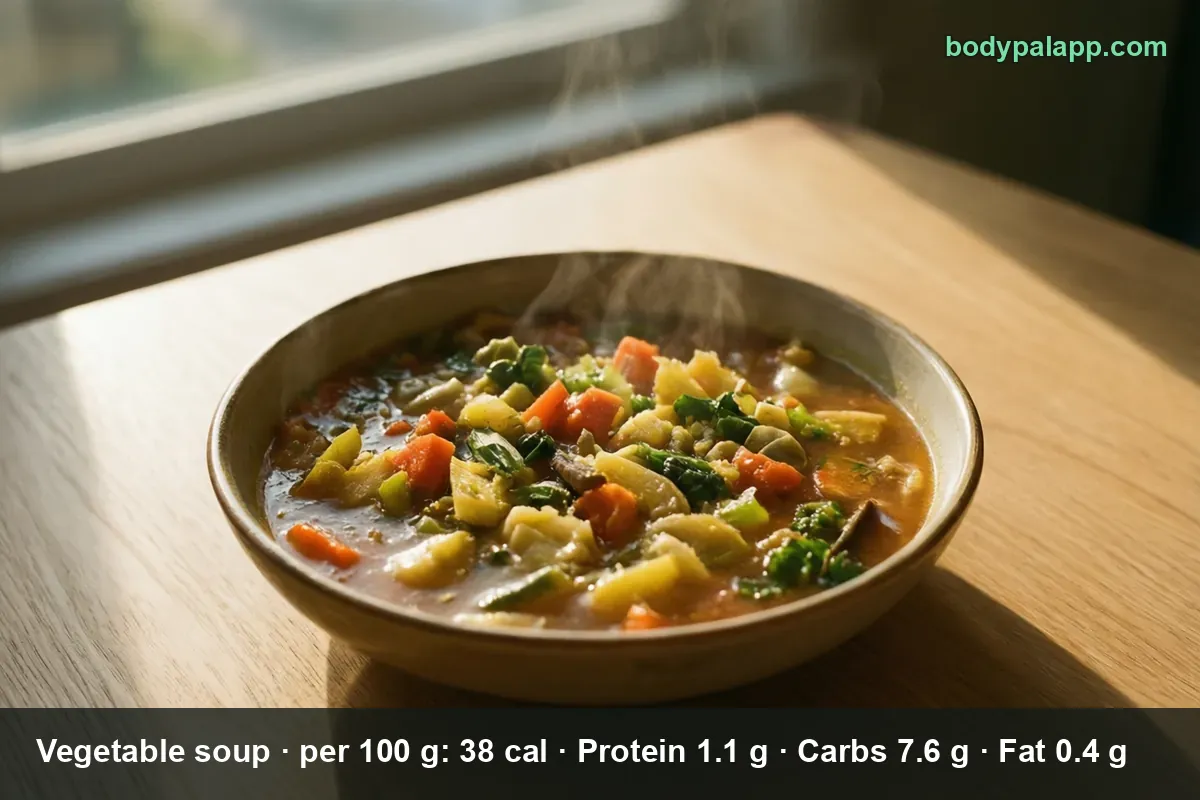
A 1-cup (245 g) serving of canned vegetable soup carries 93 calories, and the soup itself runs 38 calories per 100 g — one of the lightest things you can put in a bowl and still call lunch. The whole can is 200. Sodium, not calories, is the number that actually moves here.
On this page
- Vegetable soup quick facts
- US servings from one ounce to the whole can
- Canned homemade with meat and reduced sodium
- Cream of vegetable is a different food
- Sodium is the row to watch
- How does vegetable soup compare?
- Most popular vegetable soup brands
- Vegetable soup FAQs
Vegetable soup quick facts
Most people asking this question are holding a can or a carton of ready-to-eat soup, not a pot of stock they reduced themselves. So the row used here is FNDDS 2710111, "Soup, vegetable, canned", which comes with a household measure of 1 cup at 245 g. That is the standard American soup cup: a ladle and a half, the amount that fills a mug to the rim.
The 100 g column is the soup as USDA measures it. The middle column is that cup, and it is the number worth remembering.
| Nutrient | Per 100 g | Per 1 cup (245 g) | % Daily Value |
|---|---|---|---|
| Calories | 38 | 93 | — |
| Total fat | 0.4 g | 1.0 g | 1% |
| Saturated fat | 0.05 g | 0.1 g | 1% |
| Carbohydrate | 7.62 g | 18.7 g | 7% |
| Dietary fiber | 1.2 g | 2.9 g | 10% |
| Total sugars | 0.95 g | 2.3 g | — |
| Protein | 1.12 g | 2.7 g | 5% |
| Sodium | 260 mg | 637 mg | 28% |
% Daily Value is based on a 2,000-calorie diet.
Verified nutrition data
Numbers on this page come from USDA FoodData Central, the U.S. Department of Agriculture’s food composition database, and from manufacturer labels where a branded product is named. Last verified September 2026. How we verify our data →
Two label lines are missing on purpose. USDA does not publish added sugars or trans fat for this record, so guessing at them would be worse than leaving them out — and with 0.95 g of total sugars per 100 g, added sugar was never going to be the story. Cholesterol is 0 mg, since there is no animal fat in the broth version. Potassium comes in at 448 mg per cup, about 10% of the Daily Value, most of it from the carrots and cabbage.
For the percentages themselves, the reference amounts are the FDA Daily Values on the Nutrition Facts label.
US servings from one ounce to the whole can
| Serving | Weight | Calories |
|---|---|---|
| 1 oz | 28.3 g | 11 kcal |
| Half a cup | 122.5 g | 47 kcal |
| 1 cup | 245 g | 93 kcal |
| One microwave container | 440 g | 167 kcal |
| One can, all of it | 525 g | 200 kcal |
| Per 100 g | 100 g | 38 kcal |
The cup, the container and the can are USDA portion sizes. The half cup and the ounce are our own arithmetic from the USDA 100 g figure, scaled down, not USDA servings — useful if you are logging a taste or a small side.
The two big rows are where people trip. A single-serve microwave container is 440 g, close to one and three-quarter cups, and nobody splits one of those in half. A standard can is 525 g, and plenty of people eat the whole thing standing at the counter. That is 200 calories, which is less than a bagel, and it is genuinely a cheap meal in calorie terms. The catch shows up in the sodium section below.
Cup and ounce are not interchangeable here either. A fluid cup of soup is 245 g, but an ounce by weight is 28.3 g, so "8 oz" of soup by weight is 227 g — about 86 calories, a touch under the cup. When a label says 1 cup (240 ml), it is measuring volume, and volume and weight only line up because soup is mostly water.
Canned homemade with meat and reduced sodium
| Version | Per 100 g | Typical cup | Calories | Sodium |
|---|---|---|---|---|
| Canned vegetable soup | 38 kcal | 245 g | 93 kcal | 637 mg |
| Homemade-style vegetable soup | 27 kcal | 245 g | 66 kcal | 595 mg |
| Reduced-sodium canned | 38 kcal | 245 g | 93 kcal | 448 mg |
| Vegetable soup with meat | 44 kcal | 245 g | 108 kcal | 610 mg |
| Vegetarian vegetable, from concentrate | 28 kcal | 245 g | 69 kcal | 828 mg |
The homemade-style and vegetarian cups here are our own arithmetic from each record's 100 g figure, not USDA household servings. The homemade-style row at 27 calories per 100 g is the lightest version on this page, and the reason is water. A pot made at home usually carries more broth per ladle than the canned stuff, so a cup comes in at 66 calories instead of 93. That advantage disappears the moment potatoes, noodles, barley or a glug of oil go in the pot — those are the ingredients that turn a 66-calorie cup into a 200-calorie one, and none of them are in the USDA record.
Reduced sodium is the row that surprises people: the calories do not change at all. Same 38 per 100 g, same 93 per cup, just 448 mg of sodium instead of 637. You are buying back 8% of a day's sodium for nothing.
The concentrate row is the trap. Vegetarian vegetable soup prepared with an equal volume of water is the lightest thing in the table after the homemade row, 69 calories a cup — and it carries 828 mg of sodium, the most of anything here. Diluting a condensed soup thins the calories, not the salt.
Store brands land in the same neighborhood. Campbell's Vegetable Soup is 46 calories per 100 g, so a cup works out near 110 by our own arithmetic; Progresso's Garden Vegetable sits lower at 35 per 100 g, about 82 a cup. Frozen bowls are their own size class: a 227 g Weight Watchers fire-roasted bowl is 59 calories on the label, while a Smart Ones southwest-style bowl of the same weight is 120.
Cream of vegetable is a different food
Adding cream stops it being a broth soup in any meaningful sense. Cream of vegetable soup runs 78 calories per 100 g, so a 255 g cup is 199 calories — more than double the broth version, and roughly the whole can's worth of calories in one serving.
| Cup | Calories | Total fat | Saturated fat | Protein |
|---|---|---|---|---|
| Vegetable soup, 245 g | 93 kcal | 1.0 g | 0.1 g | 2.7 g |
| Cream of vegetable, 255 g | 199 kcal | 12.0 g | 6.4 g | 3.6 g |
Calories are the smaller half of that story. Saturated fat goes from 0.1 g to 6.4 g a cup, which is 32% of the Daily Value from a single bowl of soup, against 1% for the clear version. Protein barely moves — 3.6 g versus 2.7 g — so you are paying 106 extra calories almost entirely in fat.
Sodium is the row to watch
Run the two numbers side by side and the shape of this food becomes obvious. A cup is 93 calories, under 5% of a 2,000-calorie day, but 637 mg of sodium, 28% of the 2,300 mg limit. The salt is roughly six times heavier, proportionally, than the calories.
Scale it up and it gets sharper. The single-serve container is 1,144 mg, half a day. The full can is 1,365 mg — 59% of a day's sodium from a meal that cost you 200 calories. The Dietary Guidelines for Americans put the ceiling at less than 2,300 mg a day for adults, so one can plus an ordinary sandwich clears it.
None of that makes canned soup a bad choice. It makes it a food where the useful lever is the label, not the portion. If you are watching sodium, the reduced-sodium can is the better pick: identical calories, 189 mg less per cup. If you are watching calories, almost any vegetable soup already wins, and the vegetables count toward the MyPlate vegetables group either way.
The fiber is a quieter win. At 2.9 g a cup, 10% of the Daily Value, a bowl of soup does more for fiber than most people expect from something this light, and the whole can delivers 6.3 g.
How does vegetable soup compare?
| Soup | Per 100 g | US serving | Calories |
|---|---|---|---|
| Vegetable soup, canned | 38 kcal | 1 cup, 245 g | 93 kcal |
| Chicken and vegetable | 33 kcal | 1 cup, 245 g | 81 kcal |
| Beef and vegetables | 48 kcal | 1 cup, 245 g | 118 kcal |
| Beef barley | 52 kcal | 1 cup, 245 g | 127 kcal |
Those cup weights are our own arithmetic from each record's 100 g figure, not USDA household servings.
Our take: on calories alone, plain vegetable soup wins almost every comparison — of the four soups here, only the chicken and vegetable version is lighter, and by 12 calories a cup. But a 46-calorie spread is not much of a decision. Protein is the real difference: 2.7 g in the vegetable cup against 7.8 g in the beef and vegetables cup. For losing weight while eating volume, plain vegetable soup is the pick. For a soup that actually holds you until dinner, spend the extra 25 calories on the beef and vegetables version, or eat the vegetable soup alongside something with protein in it.
Most popular vegetable soup brands in the United States
Ranked by how widely each product appears among foods sold in the United States, from the BodyPal food database of over 3.3 million products. Calories are the figures printed on each Nutrition Facts label, checked against USDA FoodData Central.
| Product | Calories (per 100 g) |
|---|---|
| Campbell's Vegetable Soup | 46 cal |
| Nature's Promise Lentil Vegetable Soup | 46 cal |
| Weight Watchers Fire Roasted Vegetable Soup | 26 cal |
| Smart Ones Southwest Style Vegetable Soup | 53 cal |
| Wolfgang Puck Organic Hearty Garden Vegetable Soup | 49 cal |
| Progresso Vegetable Classics Garden Vegetable Soup | 35 cal |
Brand popularity: BodyPal food database. Nutrition: manufacturer labels / USDA FoodData Central.
Vegetable soup FAQs
How many calories are in a bowl of vegetable soup?
A single-serve bowl of about 440 g holds 167 calories, roughly a cup and three quarters. Diner bowls vary a lot, so weigh yours once if you log it often. A 227 g frozen soup bowl, like the Weight Watchers fire-roasted version, is smaller and lands near 59 calories.
How many calories in 1 cup of vegetable soup?
One cup weighs 245 g and carries 93 calories, from the USDA record for canned vegetable soup at 38 calories per 100 g. That cup also brings 18.7 g of carbohydrate, 2.9 g of fiber and 2.7 g of protein, so it is filling volume rather than filling substance.
How much sodium is in canned vegetable soup?
637 mg in a 1-cup serving, which is 28% of the 2,300 mg Daily Value. The whole can pushes that to 1,365 mg, 59% of a day. The reduced-sodium version of the same soup drops the cup to 448 mg while the calories stay at 93.
Is vegetable soup good for weight loss?
At 38 calories per 100 g it is one of the lightest hot foods you can eat, and a cup at 93 calories fits into almost any day. It works through volume and 2.9 g of fiber rather than protein. Sodium, not calories, is the practical limit on how much you eat.
How many carbs are in vegetable soup?
18.7 g of carbohydrate in a 1-cup serving, 7% of the Daily Value, with 2.9 g of that as fiber and 2.3 g as total sugars. Per 100 g the soup holds 7.62 g. Thinner homemade-style versions run lower, near 5.08 g per 100 g.
Is homemade vegetable soup lower in calories than canned?
Usually yes: the USDA record for non-canned vegetable soup is 27 calories per 100 g against 38 for the canned version, so a 245 g cup is 66 calories instead of 93. It is simply thinner. Add potatoes, noodles or oil to the pot and that gap closes fast.
How many calories in a whole can of vegetable soup?
A 525 g can holds 200 calories, less than a bagel, plus 6.3 g of fiber and 5.9 g of protein. The sodium is the catch: 1,365 mg, or 59% of the 2,300 mg Daily Value, from one sitting. Reduced-sodium cans cut that by roughly a third.
Does cream of vegetable soup have more calories?
Yes, roughly double: cream of vegetable soup is 78 calories per 100 g, so a 255 g cup lands at 199 calories against 93 for the broth version. Saturated fat is the bigger jump: 6.4 g a cup, 32% of the Daily Value, versus 0.1 g in clear vegetable soup.
Similar foods
- Tom yum soup — 191 cal per bowl
- Clementine — 35 cal per clementine
- Ceviche — 158 cal per cup
- Pomegranate — 72 cal for 1/2 cup arils
- Clam Chowder — 237 cal per cup
- Chinese Chicken and Broccoli — 206 cal per cup
Count it without the math
Point the camera at the bowl and BodyPal counts the soup for you, broth and all.


How long does it take to burn off vegetable soup?
A 1-cup (245 g) serving is 93 kcal. Enter your weight and the amount you ate to see how long it takes you to burn that off:
lb
| Activity | Time to burn 93 kcal |
|---|---|
| Walking, brisk | 19 min |
| Cycling, moderate | 12 min |
| Swimming, moderate | 13 min |
| Jogging | 11 min |
| Weight training, moderate | 21 min |
Times are for a 155 lb adult at a steady pace; change the weight to see yours. The amount is set to the portion in the text (245 g); change it to what you actually ate. BodyPal works this out from your steps automatically.
Burning it off is one side of it. The other is knowing your number: work out how many calories you need a day, with macros and a goal date.